Rank 1 is cited in AI Overviews three times as often as rank 10
Summary
Organic position still moves the odds of being cited in an AI Overview, and the gap between the top and bottom of page one is wide. But in Botpresso's finance dataset most citations went to domains that were not ranking in the top 10 at all, so a rank report says little about who is filling the box.
Position and citation share answer different questions. Track the second one on its own, per query. Where a ranking domain is cited it is almost always the ranking URL itself, so improve the page that ranks rather than building an AI-friendly twin.
Rank 1 gets cited in a Google AI Overview 62.2 percent of the time it appears on the same results page. Rank 10 gets cited about 20 percent of the time, roughly a third as often. The figures come from a study of 3,320 US banking and finance keywords by Janvi Jain, an SEO at the agency Botpresso, who sampled keywords in Semrush and collected the results pages through the DataForSEO API.
The citation rate falls steadily down the first page:
| Organic rank | Cited in the AI Overview |
|---|---|
| 1 | 62.2% |
| 2 | 54.67% |
| 3 | 49.91% |
| 4 | 43.87% |
| 5 | 39.06% |
| 6 | 35.38% |
| 7 | 30.55% |
| 8 | 28.6% |
| 9 | 23.73% |
| 10 | 20.12% |
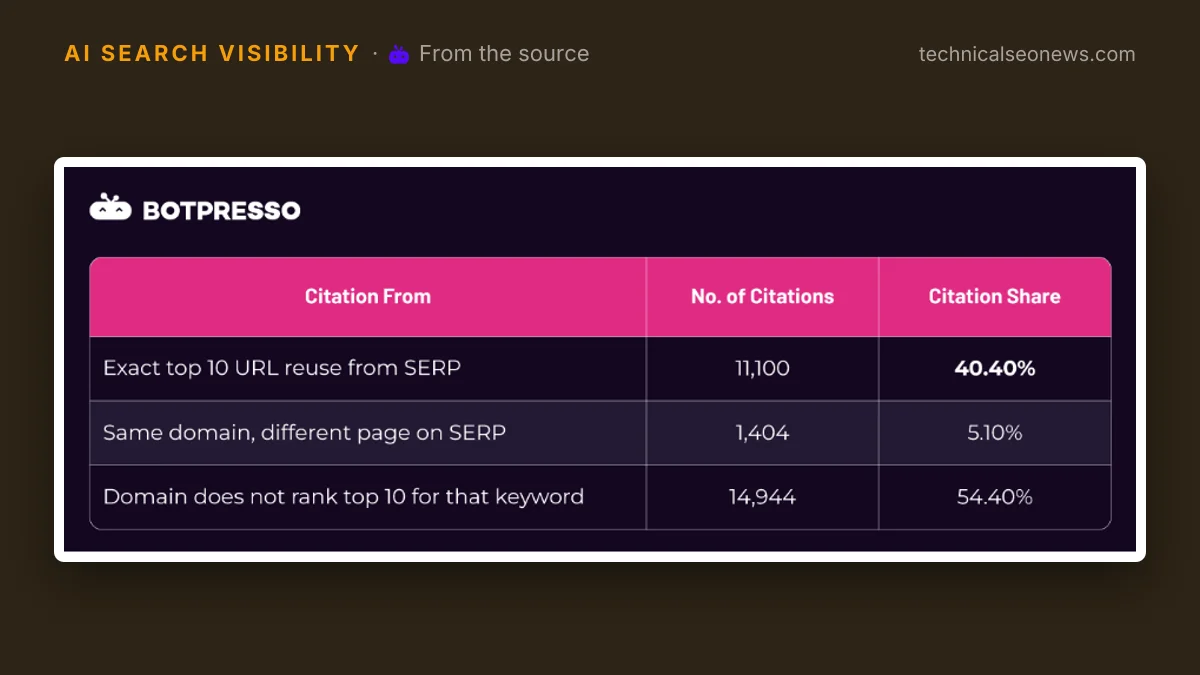
The same dataset undercuts the obvious conclusion. Of 27,448 citations, 40.4 percent pointed at a URL that was ranking in the organic top 10. Another 54.4 percent came from domains with no top-10 position on that query at all. That matches what Ahrefs found earlier this year across a far larger keyword set, where most AI Overview citations came from pages outside the top 10.
Those two findings answer different questions. The per-rank numbers describe one page’s odds: a page in the top three is cited about half the time. The citation mix describes who fills the box across thousands of queries, and the top 10 supplies a minority of it. A site can lift its own probability of being cited and still watch most of the citation pool go to competitors it never sees in a rank tracker.
Where a ranking domain does get cited, the cited page is almost always the page that already ranks. Botpresso puts that at 88.8 percent. The rest of the time the overview picks a different page on the same domain, which accounts for 5.1 percent of all citations. Building a parallel, AI-friendly version of a page is unlikely to be the thing that gets picked. The page that ranks is the page that gets quoted.
Botpresso frames the study against a line it quotes from Gary Illyes, an analyst on Google’s Search Relations team, that normal SEO is enough to rank in AI Overviews. On this evidence that is half right. Ranking work clearly moves citation probability, and domains that rank for more keywords earn more citations, a strong correlation in Botpresso’s data. What ranking does not do is deliver the citation box, because most of what fills it was never in the top 10. Normal SEO buys better odds, not the slot.
All of these rates come from one vertical. Botpresso does not compare industries, and its limitations section says the numbers may differ by industry and collection date and show association rather than causation. The likelier picture is that the pull toward established, high-ranking domains is stronger in banking and insurance than in software or travel, given how carefully Google treats sources on money topics. The curve is worth reproducing on a site’s own queries before any of these rates become a benchmark.
What to do
Track citation share as its own number, separately from position. The practical version is a recurring count over the queries that matter to the business: how many show an AI Overview, how many cite the site, and where the site ranks on each.
- Split the two measures in reporting. Share of tracked queries carrying an AI Overview, and share where the site is cited, are different lines. A rank report answers neither.
- Work the queries where the site already ranks top three and is still not cited. Those are the cheapest gaps, and on this data nearly four in ten first-place pages go uncited.
- Log the domains cited without ranking. They are invisible in a rank tracker and, on this data, they supply more than half of all citations.
Watch out for
Citations are not clicks. Botpresso measured rankings and citations, not traffic, so a rise in citation share is not evidence of a traffic recovery. Ahrefs’ own attribution work found its AI-sourced signups arriving without matching referral traffic, which is the reason to keep citation share and sessions as separate lines rather than folding them into one visibility score.