Claiming your site in ChatGPT now needs a government ID
Summary
Claiming a website in ChatGPT's new Business Hub takes a government-issued ID plus the company's legal name and tax details, and OpenAI says the claim does not improve placement.
The one reason to claim is the website-click count in Business Hub, so have the owner or an authorized representative run the identity check.
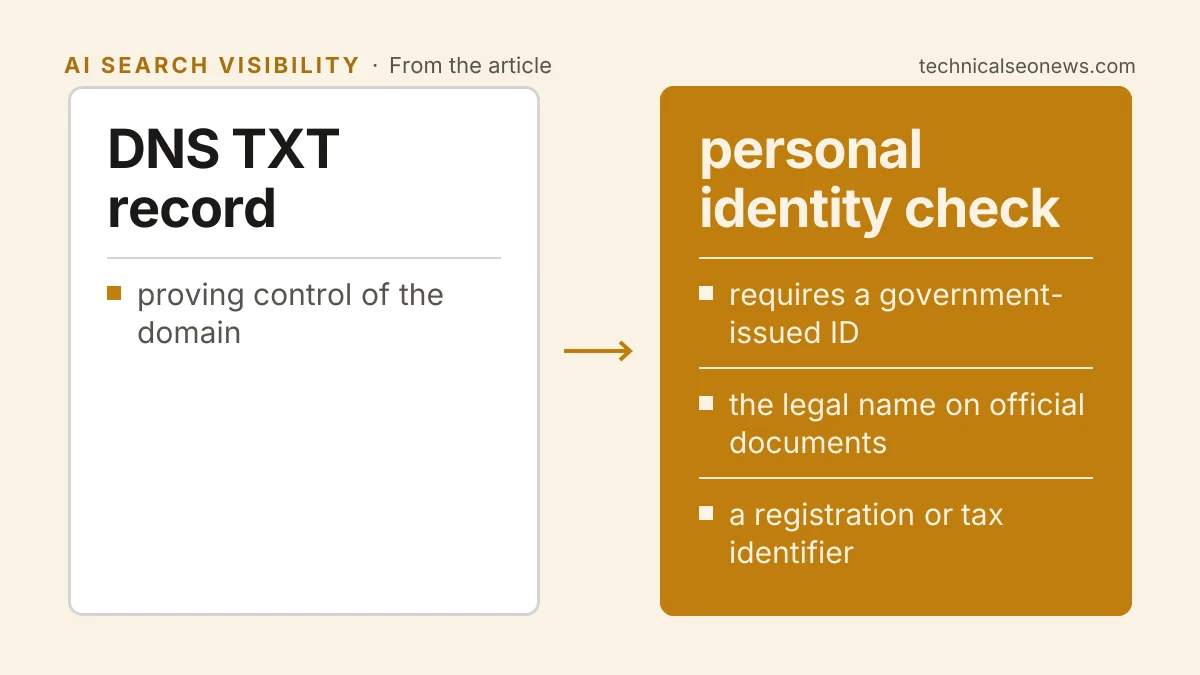
OpenAI opened Businesses in ChatGPT in beta on November 10, 2026, and claiming a website takes more than proving control of the domain. Vahan Petrosyan, Search Engine Journal’s director of technology, walked through the flow while submitting SEJ itself, and after the DNS TXT record came a personal identity check that requires a government-issued ID.
The rest of the form is company paperwork. It asks for the public business name, the legal name on official documents, any DBA, whether the business is a sole proprietorship or an entity, a physical address that cannot be a P.O. Box, the legal registered address when that differs, and a registration or tax identifier for the business’s country. The ID scan runs through Persona, which handles it by QR code or a phone link using the camera, with no app to install. Verification came back almost instantly in SEJ’s case.
Claiming buys reporting. Business Hub reports mentions and website clicks, and SEJ’s profile showed 353,356 mentions and 2,663 website clicks. OpenAI aggregates the figures and applies reporting thresholds, so a smaller business should expect gaps rather than a complete count.
The mentions total is softer than its size suggests. For an online business, a mention only registers when ChatGPT references the site, and the brand name on its own does not count, per SEJ’s piece. So the better bet is to read the clicks line and treat the mentions figure as background: ChatGPT clicks often land as direct traffic in analytics, and this is the only first-party count of them. The charts themselves turned up in ChatGPT’s interface before the feature launched.
Claiming does not change placement. OpenAI’s business overview says claiming a business does not guarantee higher placement, that ChatGPT still makes its own recommendations and comparisons, and that profiles can include information from other sources. The trade is documents for measurement, nothing else. For a company with a real legal entity and someone authorized to hold up an ID, that is a reasonable deal. For a one-person site whose owner would rather not put a government ID through a third-party vendor, there is nothing on the visibility side to argue the other way.
ChatGPT also accepts online-only businesses, which Google’s Business Profile does not. SEJ’s piece notes that Google’s eligibility guidelines list brands, organizations, artists and other online-only businesses as ineligible, so a publisher, SaaS product or agency can claim a listing here that it could never claim at Google. U.S. Stores and restaurants take a different route, since OpenAI’s setup guide says they can claim an existing listing with a code sent by SMS or an automated call to the listed phone number, which has to be answerable during business hours.
What to do
Have the owner or an authorized representative run the identity check, because OpenAI’s eligibility requirement allows either, and the contractor who holds DNS access is not necessarily one of them. Check which identifier the form wants for your country before typing anything into the registration number field, which showed a 12-1234567 placeholder that reads like a U.S. Employer Identification Number (EIN) even though a state registration number is a different number entirely. Read the saved draft in full, including the category, the description and the delivery and returns answers, since approval automatically publishes new profiles created through Persona. After that, check the website-clicks line monthly and do not expect the profile to earn the site more answers.