ChatGPT shifted its citations from explainers to primary sources
Summary
ChatGPT now cites the sites that publish the underlying evidence, such as research indexes, regulators and product testers, more often than the sites that explain it. Ahrefs confirmed the shift on prompts that ran in both months, so it is not a sampling artifact.
The practical question is whether ChatGPT reaches for your page or for whatever your page cites. Check which domains it names on your core topics, then move effort to work only you can publish.
Sites that publish original research and data climbed ChatGPT’s most-cited list between March and September, while the sites that summarize that work fell. Ahrefs’ analysis, reported by Search Engine Journal on October 12, ranks the 200 domains ChatGPT cites most often in US answers. It compares 2.4 million answers from March with 3.8 million from September.
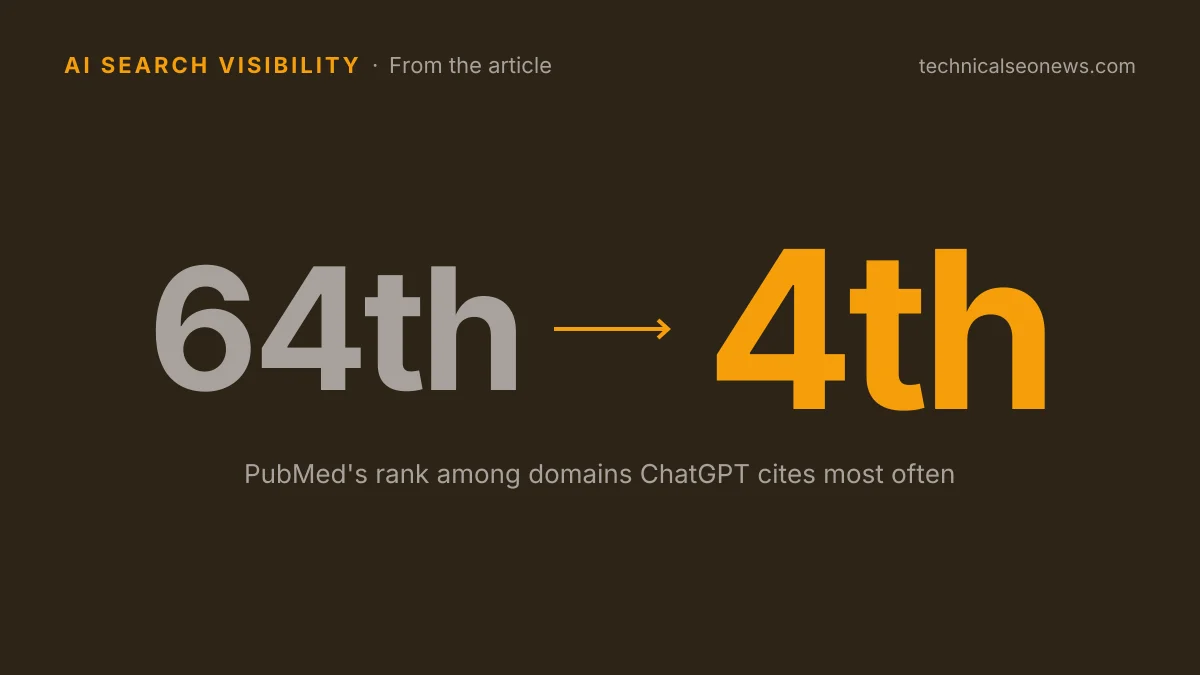
PubMed is the US government’s index of published medical research. WebMD is one of the health sites Ahrefs describes as summarizing that research. The two moved in opposite directions.
| Domain | March | September |
|---|---|---|
| PubMed | 64th | 4th |
| WebMD | 18th | 79th |
Britannica, Investopedia and the New York Post left the top 200 entirely. Ahrefs’ summary of the pattern is that ChatGPT “seems to be prioritizing original sources over sites that summarize them.”
The domains gaining rank came from three places:
- government health and research sites such as PubMed and the FDA
- regulators such as the Consumer Financial Protection Bureau and the FTC
- hands-on product testing sites such as RTINGS
Support pages from Google and Microsoft gained too. The fallers were health and finance explainers. Ahrefs groups WebMD, Verywell Health, Healthline and Investopedia together as sites that summarize what someone else published.
A rank move in this kind of dataset can be an artifact of the measurement. Ahrefs adds prompts to its tracking over time, so a domain can rise because the question set changed rather than because ChatGPT changed. The company isolated roughly 25,000 prompts that appeared in both March and September among its 150,000 highest-volume prompts, and every site on the chart moved the same direction within that subset. Without that check the chart would be a curiosity.
Reddit and Wikipedia fell harder than any explainer. Reddit was cited in 19.1% of US ChatGPT answers in March and 2.3% in September. Wikipedia went from 14.1% to 2.9%. Both are still among ChatGPT’s most-cited domains, so the change is in how often they get reached for rather than whether they qualify. That fits the same report’s finding that ChatGPT’s background searches go to brand domains directly rather than through aggregators.
None of this measures traffic, and Ahrefs says so. Citation rank tells you which documents the model reaches for, which is a different question from whether anyone arrives. Ahrefs’ own attribution work found AI visibility turning up in signups rather than referral sessions.
What to do
Run your core topics through ChatGPT and record which domains it cites. If it names the regulator, the dataset or the manufacturer’s own page rather than your write-up, the likelier problem is the type of page and not its quality.
Ahrefs’ recommendation is to spend the effort on pages only you can produce: original research, your own hands-on testing, and your own product information. For a site whose visibility rests on explainers, that is a content plan rather than an edit.
Repeat the check after each OpenAI model release. Ahrefs says the pattern could shift again with the next model update, and Search Engine Journal’s piece suggests rechecking whenever that happens. A six-month comparison of one market is not a standing rule.