OpenAI's partner publishers lost ChatGPT citation share since July
Summary
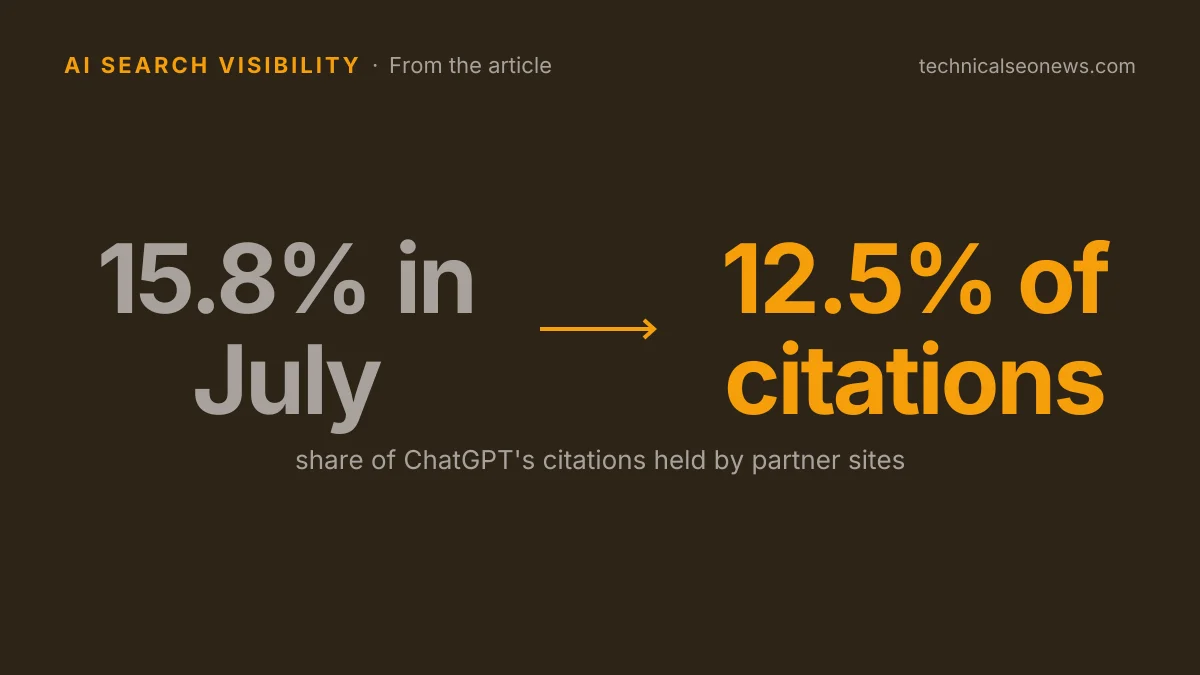
OpenAI's licensed publisher partners now take 12.5% of ChatGPT's citations among its most-cited domains, down from the July peak, so a deal with OpenAI does not shut other sites out of the answers.
Pull the Cited domains report for your niche in Ahrefs Brand Radar and treat the partner publishers already cited there as PR targets.
OpenAI’s licensed publisher partners are taking a smaller share of ChatGPT’s citations than they did in the summer. Across the 200 domains ChatGPT cites most, partner sites held 12.5% of citations in late September, down from 15.8% in July, according to Ahrefs’ run-down of every OpenAI publisher partnership, published 3 November by Ryan Law, Ahrefs’ director of content marketing.
Those shares come from Ahrefs’ earlier query fan-out study, where the partner share sat at 7.5% in March. The new work is per domain: Ahrefs checked 85 partner domains in Brand Radar, its AI visibility tracker, against an index of 5.5 million US ChatGPT answers from November, and counted how many of those answers link to each one. Ten partner domains sit among ChatGPT’s 50 most-cited sites. Forty-seven make the top 500.
The partners cited most often are review and lifestyle titles rather than news brands. Five of them clear 30,000 answers each in the November snapshot.
| Partner domain | ChatGPT answers citing it |
|---|---|
| vogue.com | 42,108 |
| caranddriver.com | 41,603 |
| tomsguide.com | 36,439 |
| goodhousekeeping.com | 35,728 |
| techradar.com | 31,415 |
The Guardian is the lowest-placed partner inside ChatGPT’s top 50, at 50th.
A deal alone does not get a site cited. Future, the UK specialist publisher behind TechRadar, Tom’s Guide and PC Gamer, earns more ChatGPT citations than any other partner group, and its single agreement covers domains ranging from the 15th most-cited site to ones outside the top 2,000. The Week, also Future’s, appears in 634 answers. The likelier driver is subject matter, since the questions people bring to ChatGPT are often buying questions, and that is what Future’s reviews and Hearst’s Car and Driver already answer. Ahrefs makes the same point about Future’s portfolio.
The counts are a single snapshot, and citations churn underneath them. Ahrefs tracked more than 1,300 prompts daily for four weeks and published the result earlier: half of AI citations drop by day two. Only about a quarter of the pages ChatGPT cited for a prompt were cited again the next day, while the most-cited domains moved by about 14% from one day to the next. So the domain-level counts are steady enough to build a target list from, while a single cited URL is not worth chasing.
A 12.5% share also means most of what ChatGPT cites still comes from sites with no deal at all. Licensing helps a publisher, but it is not the only way into the answers.
What to do
The partner list is most useful as a target list for digital PR.
- Open Brand Radar, enter keywords for your niche, open the Cited domains report and set it to ChatGPT. Cross-check the domains it returns against Ahrefs’ partner list, and treat any partner already cited in your niche as a strong PR target.
- Judge each domain on its own citation count rather than its owner’s deal. Sitting inside Future or Vogue’s owner, Condé Nast, says nothing about whether that particular title gets cited for your topic.
- Read the counts as a floor if your market is not the US. Brand Radar’s index here holds US answers only, so partners publishing mainly in other languages are undercounted.
- Reddit and Stack Overflow are on the partner list too, and mentions there come from taking part in threads rather than from a pitch. Earlier tracking found Reddit mentions track AI visibility more closely than the press.