Answering up front tracks AI retrieval more than citation
Summary
In TJ Digital's analysis of 193,507 AI answers, opening a page with a direct answer went with whether the AI retrieved the page at all far more than with whether it cited the page.
Before rewriting intros, check whether the AI pulls the page up at all, because pages it never retrieves are where the gap is widest.
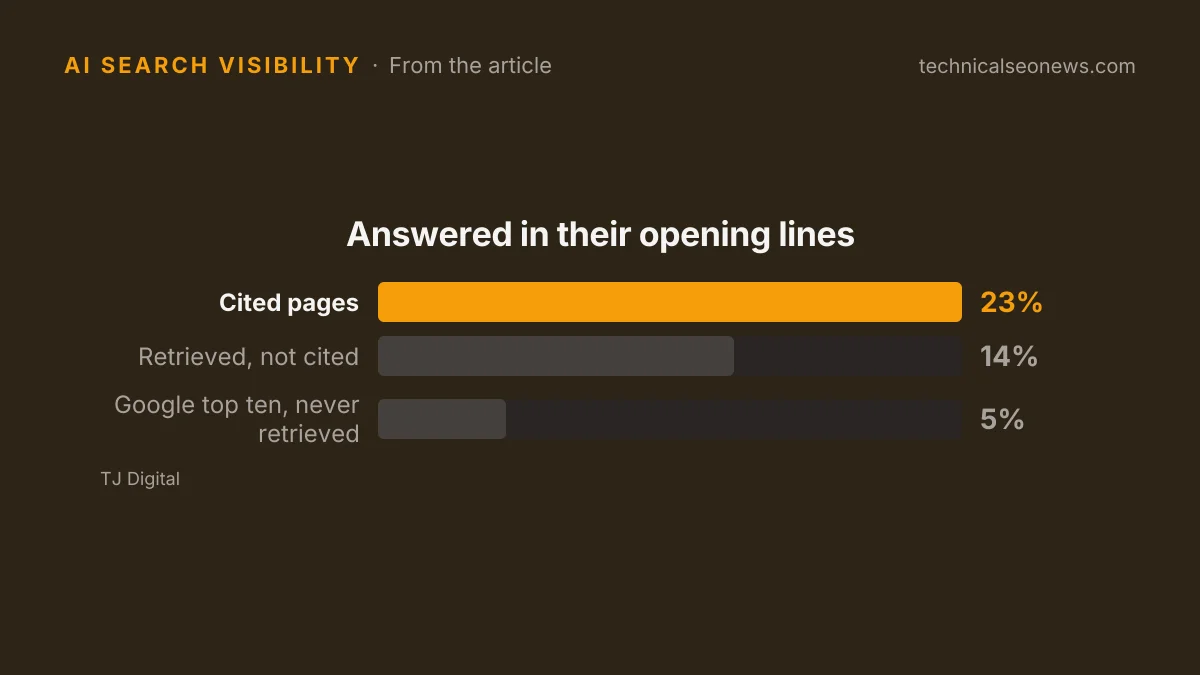
Cited pages opened with a direct answer to the question 23% of the time, against 14% for pages the same AI answer pulled up and then skipped. Search Engine Journal’s write-up covers the analysis, run by TJ Robertson of TJ Digital, an agency that sells SEO and AI-visibility services, across 193,507 answers from ChatGPT, Google AI Mode and AI Overviews.
The wider gap sits one step earlier. A separate round of ratings paired cited pages against pages that ranked in Google’s top ten for a keyword matched to the question but never came up in the AI’s own searches, and 5% of those never-retrieved pages answered in their opening lines. Both rounds were scored blind by AI raters who did not know which page in each pair had been cited.
| Comparison set | Cited pages | Comparison pages |
|---|---|---|
| Retrieved, not cited | 23% | 14% |
| Google top ten, never retrieved | 20% | 5% |
Search Engine Journal’s piece says it directly: the difference shrank when the uncited pages were also being retrieved. The likelier explanation is that opening with the answer does most of its work at the retrieval step, getting a page into the pool the AI searches up, and much less at the step where the model picks which of those pages to name. One caveat: the never-retrieved pages were chosen from Ahrefs rankings for keywords matched to the questions, and half of those keywords were broader than the question asked, which would lower their answer rate on its own. Even so, rewriting an intro to win citations is a bet on the narrower of the two gaps.
A citation is also not evidence that a page answered anything. In the round that used never-retrieved pages, 23% of the cited pages had no answer to the question anywhere in the portion raters read, and half of the passed-over pages had none. Cited pages did rate higher for completeness, though both sides landed in the bottom half of the raters’ five-point scale. Google writes its own summaries into AI Overview citation cards rather than quoting page text, so even the citation card is not a quote from the page.
Robertson says he treats the findings as associations rather than page traits that cause citations, and the rest of the analysis argues for that caution. A year in the title came with more than twice the odds of a citation, while an author byline came with 28% lower odds, a result Robertson says he cannot explain and would not act on. Search Engine Journal’s writer points to the precedent: Ahrefs reported in May that AI-cited pages were about three times as likely to carry JSON-LD, then tested adding schema and found it did not raise AI citations.
What to do
Split the questions you track into three states rather than two: never pulled up, pulled up and skipped, cited. The opening-answer pattern only argues for an intro fix on the middle group. For pages the AI never searches up, the first paragraph is not what is holding them back.
On product and service pages, check whether the buyer’s question gets a plain answer in the first screen. That is the one recommendation the study supports on its own merits.
Run anything beyond that as a before-and-after with a control group on your own tracked questions, the way Ahrefs tested schema. Robertson’s analysis compares pages as they already were, so it cannot show that adding a direct answer changes how often a page gets cited. Two details were also still missing from his write-up as of October 28: how many pages the cited-against-retrieved round covered, and which model scored them. Treat the 23-to-14 split as the softer of the two numbers.
Leave author bylines and calls to action in place. Both came with lower citation odds in this data, and Robertson has no account of why.