ChatGPT's searches name their source and a freshness window
Summary
ChatGPT's background searches now show where each result came from and how recent it must be, with commercial comparison queries asking for results from the last 30 days.
Before committing to a target prompt, run it in ChatGPT with the DevTools Fetch/XHR tab open and read whether it searches at all and which result_source it uses.
ChatGPT’s background searches carry a label naming where each result came from, and a number setting how recent those results have to be. Mark Williams-Cook, director at the agency Candour and co-founder of the People Also Ask tool AlsoAsked, published the method in Search Engine Journal on October 21. Both fields sit in Chrome DevTools under the Network tab filtered to Fetch/XHR.
The field naming the origin is result_source, and Williams-Cook’s piece gives three values:
serp, live web results scraped from a search engine in the background.labrador, OpenAI’s own index.bright, Bright Data, which sells structured commercial data packs.
Tomek Rudzki, researching for the AI visibility tool Peec AI, later found the field only ever carries four values, the fourth being Oxylabs, another data provider. Which label answers a query matters more than the technique that found it. A serp answer is being fetched while the question is being asked. A labrador answer is drawn from what OpenAI has already indexed, so the safer read is that a page published today will not change it until that index refreshes.
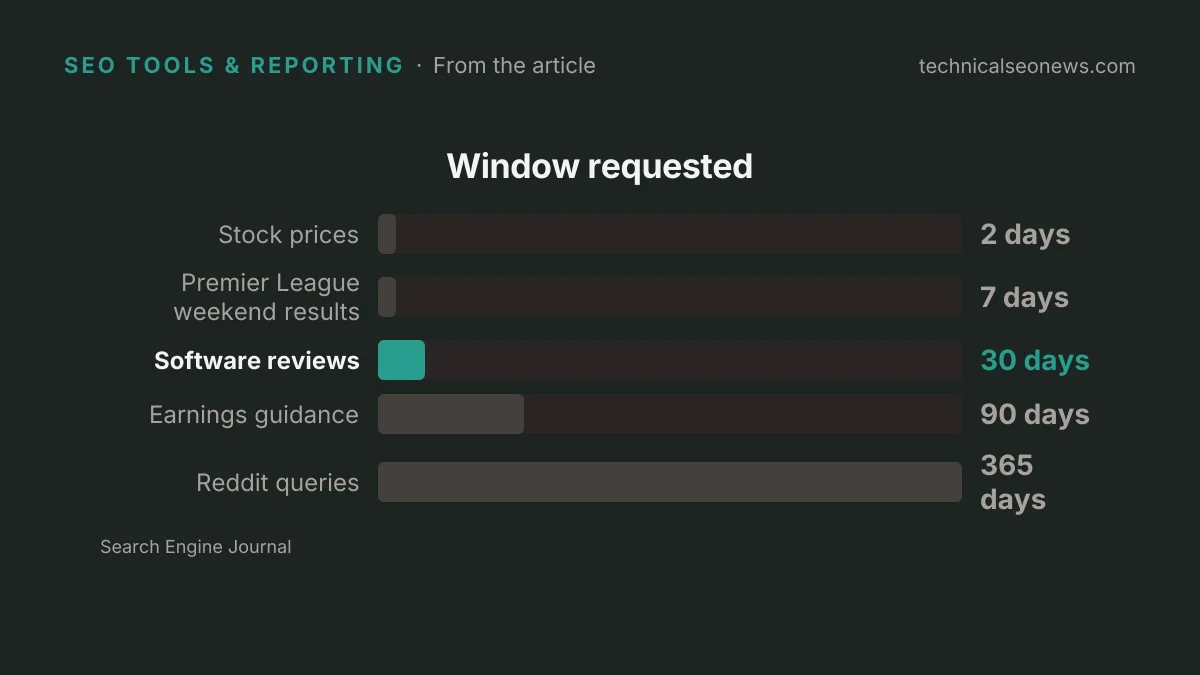
The second field sits at the end of each fan-out query, after a vertical pipe: a time window in days. It varies by what the query is about.
| Query type | Window requested |
|---|---|
| Stock prices (“Is Nvidia overvalued”) | 2 days |
| Premier League weekend results | 7 days |
| Software reviews (“Best AI live chat software”) | 30 days |
| Earnings guidance | 90 days |
| Reddit queries | 365 days |
Thirty days is the figure worth holding onto, because it covers the commercial comparison queries most SEO work targets. Williams-Cook does not spell out the consequence, but the likelier reading is that results outside the requested window are filtered out before the model composes anything. If so, a page’s last genuine update matters on those queries, and a touched timestamp does not.
The windows also expose something citation counting cannot see. Reddit queries get a full year, and the fan-out searches lean heavily on site: queries with Reddit still among them, so ChatGPT is reading Reddit roughly as much as ever while citing it far less. Counting citations, including the shift toward primary sources recorded earlier, measures what the model shows a user, not what it read to get there.
The fields drift, which limits how much weight any single reading carries. Williams-Cook writes that the way ChatGPT sends its network data has changed radically over the last few months, apparently at random, and that the search_queries field he and fellow researcher Suganthan Mohanadasan relied on vanished entirely. Anything read this way is a snapshot of this week, not documentation.
What to do
- Run your highest-value target prompts in ChatGPT with DevTools open (F12), Network tab, filter set to Fetch/XHR, then read the
result_sourcevalue and the number after the pipe on each fan-out query. Most of it streams through the EventStream tab while the answer is being generated. - Sort those prompts by whether retrieval happens at all. Williams-Cook’s own recommendation is that prompts which trigger a search are where effort pays off now, while prompts answered from the model’s training are a long-term project that no new landing page fixes next week.
- Among the prompts that do search, treat
serpqueries as ordinary ranking problems. Those results are scraped from a search engine, so a page that does not rank for the fan-out query is not in the pool ChatGPT reads from, whatever the page says. Alabradorquery is slower work, since the page has to enter OpenAI’s index first. - Keep watching Reddit threads that match your target queries. Williams-Cook’s finding is that the retrieval is still happening there, so a brand discussed badly on Reddit can feed an answer that credits nobody.