Citations per Perplexity answer doubled as its referrals fell
Summary
Cited URLs per answer and estimated referral traffic moved in opposite directions on ChatGPT, Gemini and Perplexity in HubSpot data covering nearly 210 million prompt runs, so a rising citation count does not show a brand gained ground.
Divide your cited URLs by all cited URLs in the same answers and report that share on a fixed prompt set.
Cited URLs per answer and estimated AI referral traffic moved in opposite directions on ChatGPT, Gemini and Perplexity this summer, according to Kevin Indig’s November 23 analysis of a HubSpot export covering nearly 210 million prompt runs. Indig, who writes the Growth Memo newsletter on SEO and growth, found the correlation between the two was negative on all three engines.
A citation count goes up when an engine decides to show more links, whatever the brand did that week. Indig’s name for the total citations and mentions an engine hands out per answer is the denominator, and when it doubles, a brand’s own count doubles with it. A raw cited-URL count therefore measures the engine’s output format first and the brand’s standing second.
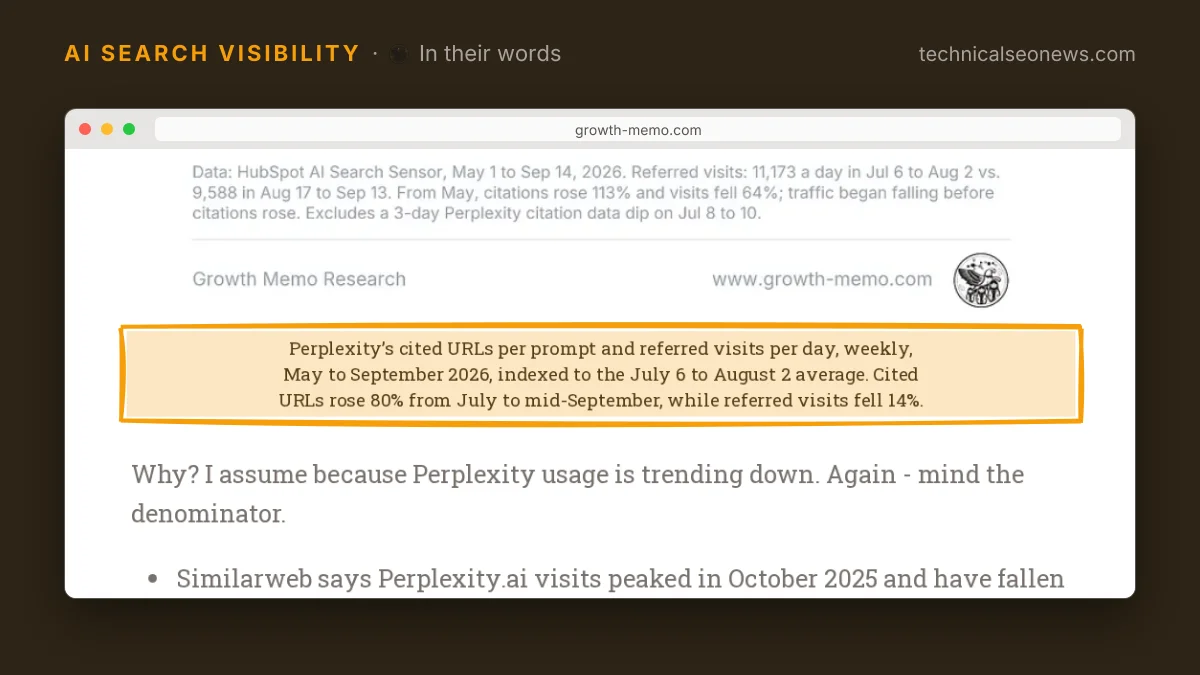
Perplexity is the clearest case in the data. Indig compared two four-week windows, one in July and one running from mid-August to mid-September:
| Window | Cited URLs per answer | Estimated referrals per day |
|---|---|---|
| July 6 to August 2 | about 9 | about 11,200 |
| August 17 to September 13 | about 18 | about 9,600 |
Referrals depend on how many people use an engine, Indig argues, not on how many links each answer carries.
ChatGPT and Gemini ran the other way across the same windows, showing fewer cited URLs per prompt while estimated referrals rose. Citation direction did not predict referral direction on any of the three. The correlation between cited URLs per prompt and AI-referred visits per day:
| Engine | Correlation |
|---|---|
| ChatGPT | −0.36 |
| Gemini | −0.53 |
| Perplexity | −0.58 |
Baselines also shift overnight. An August 6 update to ChatGPT 5.6 lifted cited URLs per prompt by 51 percent. Around August 25 the citation rate fell 55 percent. On August 13, the day Gemini 3.7 Flash reached general availability, citations per prompt dropped 27 percent against the day before. Positions in AI answers already change on two days in three, and these figures say the supply of citations behind them moves as well. Annotate a reporting period with model release dates before reading a change as the result of your own work.
The traffic side of this is modeled rather than counted. HubSpot’s AI Search Sensor, a free dashboard of AI answer trends, bases AI-referred traffic on anonymized customer data modeled into weekly visit trends, and Indig notes the export does not connect individual citations to visits. The negative correlations are not evidence that being cited costs a site traffic. They are evidence that a citation count does not forecast traffic, the same trap as reading a modeled traffic estimate as a count.
What to do
- Divide your cited URLs per prompt by all cited URLs in the same answers, and your brand mentions by all mentions across your competitor set. Share answers the question a count cannot.
- Hold the prompt set, the brand cohort and the time window fixed between reports. These figures are aggregate and a single brand’s tracking will differ, so compare your brand only against itself across identical runs.
- Track the share of answers that name your brand separately from citations. On ChatGPT the two correlated slightly against each other between July and mid-September, at minus 0.23.
- Pull GA4 referrals from chatgpt.com, gemini.google.com and perplexity.ai, then compare them against each engine’s own visit trend in Semrush or Similarweb before blaming your content for a drop.
- Log model and interface release dates alongside your reporting periods, for every engine you report on.