Claude plugin for GSC and Ads won't replace your SEO stack
Summary
An SEO user claimed a Claude plugin replaced their $500/month tool stack, but the post was removed after community members identified it as an advertisement for a required paid service called adsagent.org.
LLM plugins that query Google APIs can't replicate the proprietary crawl indexes, backlink databases, and historical data that established SEO tools provide, making them unsuitable replacements.
When evaluating LLM SEO tools, verify they access data beyond what Google already provides and don't route credentials through third-party services that pose security risks.
What happened
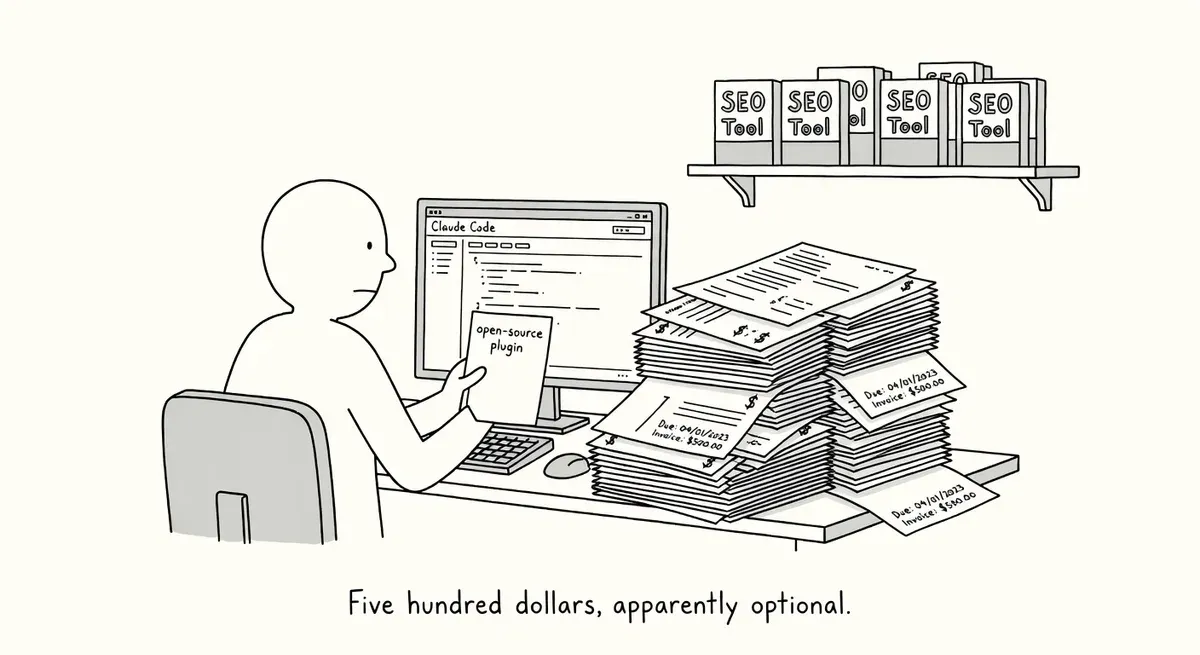
A user on r/TechSEO posted an AMA claiming they replaced a $500/month SEO and Google Ads tool stack with a single Claude Code plugin. The post, titled “I replaced my 500USD/mo SEO + Google Ads stack with a Claude Code plugin. Open-sourcing it,” was removed by moderators. The project appeared to require an external service called “adsagent.org” to function.
Community response was largely negative. Several commenters identified the post as a thinly veiled advertisement for the adsagent.org service, which linked back to the GitHub project. One commenter, u/jasongill, called it out directly: “This is clearly an ad for ‘adsagent.org’ which is required to use it.” Another user, u/WebLinkr, labeled it “AI content phishing.”
Why it matters
The post reflects a growing pattern of open-source tool announcements in SEO communities that function as lead generation for paid services. The “open-sourcing it” framing suggests free tooling, but requiring an external paid dependency undermines that premise.
The underlying idea of using LLM-based plugins to interact with the Google Ads API and Google Search Console API is technically plausible. Google provides programmatic access to both services. The Google Ads API supports automated account management, custom reporting, and campaign management at the keyword level. Connecting an LLM to these APIs could help with natural-language querying of performance data or generating reports.
The gap between “technically possible” and “production-ready replacement for your SEO stack” is enormous. Tools like Ahrefs, Semrush, or SE Ranking don’t just pull API data. They maintain their own crawl indexes, backlink databases, keyword difficulty scores, and historical trend data. An LLM plugin that queries GSC and Google Ads APIs cannot replicate those datasets.
One commenter, u/Empty-Employment8050, made a practical observation: “you could just take this framework and build it yourself in like an afternoon.” The comment highlights that the API integration itself is straightforward. The value in paid SEO tools comes from proprietary data and long-running infrastructure, not from the API connection layer.
What to do
No action is needed on this specific tool, which was removed by moderators. The broader trend of LLM plugins for SEO APIs is worth understanding, though.
If you’re evaluating LLM-based SEO tools that claim to replace established platforms, check these things:
- What data sources does it actually access? A plugin that only queries GSC and Google Ads APIs gives you data you already have in those platforms. The value of third-party SEO tools is in data Google doesn’t provide, like backlink profiles, competitor keyword gaps, and crawl analysis.
- Does “open source” require a paid service? Check the dependencies. If the plugin routes requests through a third-party service, you’re not self-hosting anything meaningful.
- What authentication model does it use? Any tool connecting to Google APIs needs proper authentication. Google’s Application Default Credentials documentation outlines how credential discovery works. Passing your Google credentials through an unknown third-party service is a security risk for accounts with ad spend or sensitive search data.
LLM plugins that wrap Google APIs can be useful for ad-hoc querying and reporting automation. Treating them as replacements for a full SEO tool stack overstates what API access alone provides.
Watch out for
Credential exposure through third-party proxies. If an LLM plugin requires routing your Google API authentication through an external service like adsagent.org, your GSC and Google Ads credentials may be exposed to that service. Review the authentication flow before connecting any tool to accounts with ad spend.
Conflating API access with competitive intelligence. GSC data covers your own site’s performance. Google Ads API covers your own campaigns. Neither provides competitor backlink data, SERP feature tracking, or third-party crawl data. A plugin that queries these APIs cannot replace tools that maintain independent indexes.