Facebook's AI-written answer pages rank in Google and AI Mode
Summary
Meta is publishing AI-written summaries of public Facebook posts at facebook.com/fb-answers/, and more than 6 million of them are indexed and ranking in Google.
Search your top head terms now and record where fb-answers URLs appear above you, in the classic results and in AI Overviews and AI Mode citations.
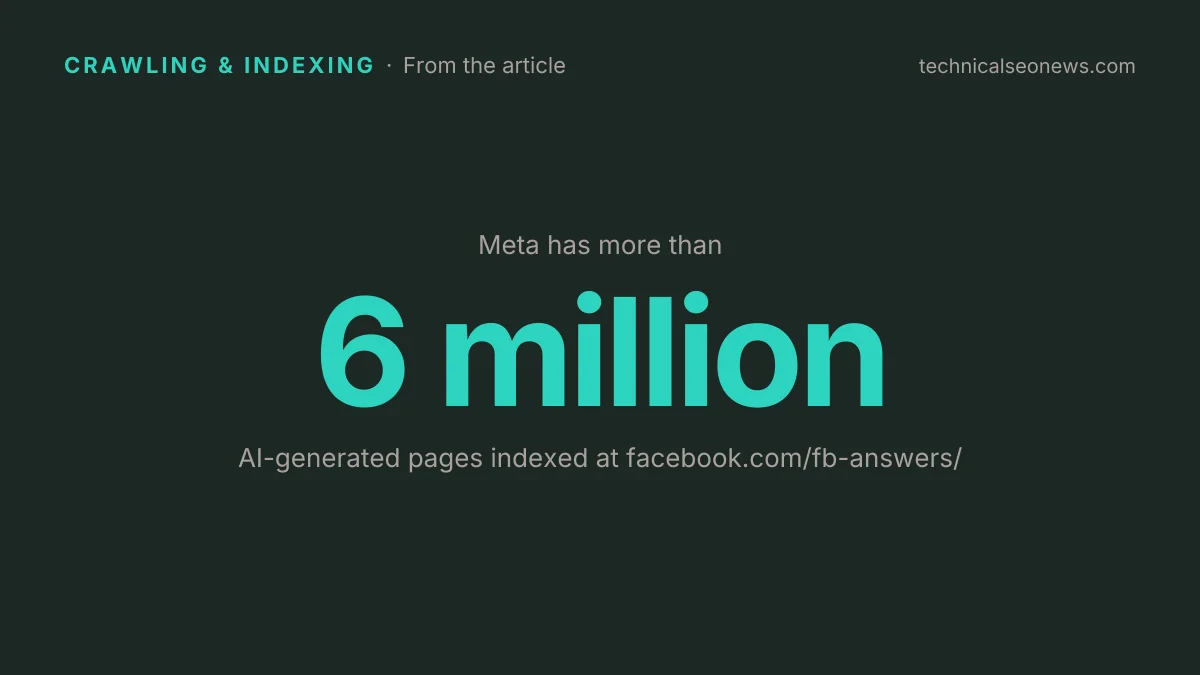
Meta has more than 6 million AI-generated pages indexed at facebook.com/fb-answers/, and they rank in Google’s classic results, AI Overviews, AI Mode and Gemini, per Search Engine Roundtable’s write-up of 5 November. Each page is an AI-written summary of one topic, built from public Facebook posts by individuals and pages, which the page lists as its sources. The write-up quotes no response from Google.
Saul Westbrook, a search specialist at Peripheral Creative who documented the pages, says he noticed them in June 2026, already numbering in the millions and showing up frequently in Google results. Glenn Gabe, an SEO consultant at G-Squared Interactive who flagged the directory on X, called it “massive ‘Scaled content abuse’” and said it ranks for millions of queries across the ten blue links, AI Overviews and AI Mode.
Scaled content abuse is Google’s own term for publishing pages at volume whose main purpose is ranking rather than helping the person reading them. Nothing in the piece says whether Google agrees that the term applies. Barry Schwartz, who wrote the Search Engine Roundtable piece, expects the pages to stop being indexed now that the scale is public, and says he has heard unconfirmed talk of Instagram running something similar.
The safer assumption is that the pages stay. The directory has been live and growing since the middle of the year, the piece quotes no Google statement to point at, and an enforcement action against Meta’s own domain would be a much larger move than the sampling and crawl cuts Google usually applies to scaled content.
What the pages cost depends on the surface they win. An fb-answers URL sitting at position six on an informational query takes clicks from everyone below it, which a rank tracker will show. The same URL cited inside an AI Mode or AI Overviews answer takes a citation slot instead, and citation selection does not follow blue-link position, as an earlier finding that most AI Overview citations come from outside the top 10 showed. Checking only the ten blue links will therefore understate how much of a query Meta already holds.
What to do
- Search your top head terms and note every fb-answers URL, in the classic results and in AI Overviews and AI Mode citations. Save dated screenshots. If the directory is deindexed in a month, that record is the only before-and-after anyone will have.
- Look hardest at informational queries built on opinion and firsthand experience, since public posts are what these pages assemble.
- Track it as a competitor rather than waiting on enforcement. A spam report is harmless, but the scale is already public and widely discussed, so it tells Google nothing new.
- Do not read the silence as permission to copy the pattern. The likelier outcome is that a small site publishing a million AI summaries of other people’s posts gets far less patience than Meta is getting.