Six new studies measured AI traffic conversions, they all disagreed
Summary
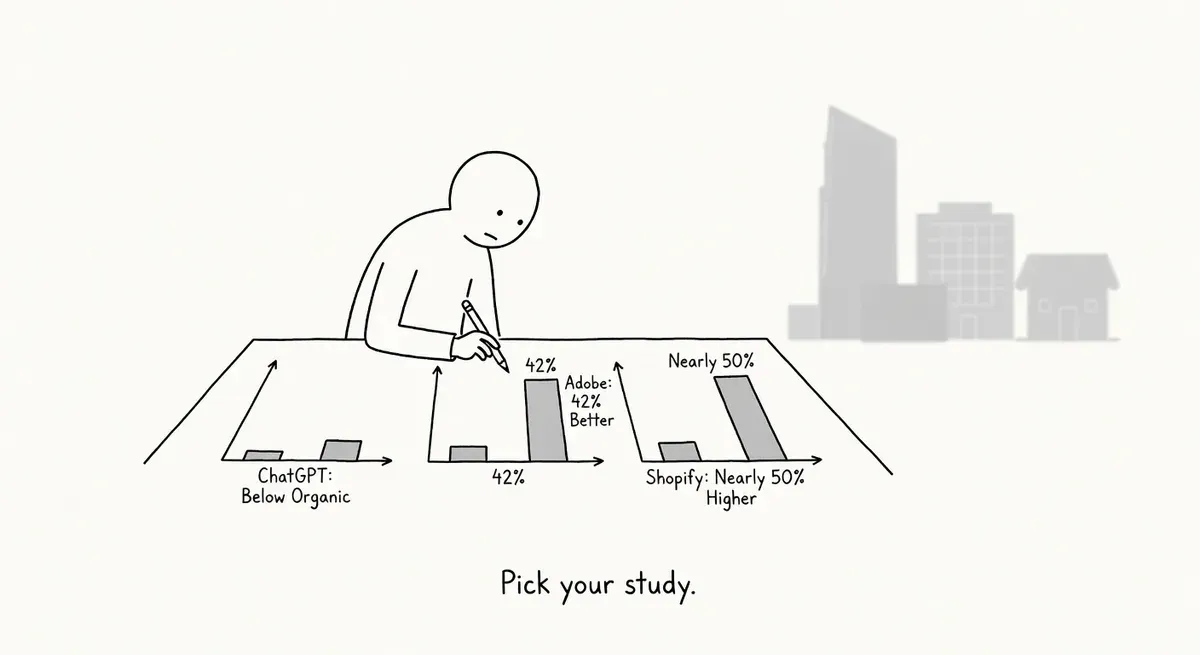
Six independent studies measured AI traffic conversion in Q1 2026 and produced contradictory results, from below organic (Marketing Science peer-reviewed study) to 42% better (Adobe) to nearly 50% higher on product pages (Shopify). The contradictions reflect different populations, different definitions of 'AI traffic,' and different measurement scopes.
Meanwhile, 70.6% of AI referrals are invisible in analytics, the US-EU conversion gap is 8.5x, and autonomous agents visiting your checkout fail on account creation and 2FA.
Practitioners need to fix attribution before the conversion numbers mean anything.
Six independent studies released AI traffic conversion data for Q1 2026. A peer-reviewed paper in Marketing Science found ChatGPT converts worse than organic search. Adobe’s quarterly report found AI traffic converts 42% better than non-AI. Shopify’s platform data found AI-referred visitors convert nearly 50% higher on product pages.
All three used real transaction data. All three are defensible. None of them agree.
The contradiction is not noise. “AI traffic” is not one channel. It is several, measured differently, across populations that barely overlap.
What each study actually measured
The studies differ in population, scope, and what they call a conversion.
Kaiser and Schulze, the only peer-reviewed study in the set, analyzed 12 months of first-party data from 973 ecommerce sites generating $20 billion in annual revenue. They tracked 50,000 ChatGPT transactions against 164 million from traditional channels. ChatGPT converted below organic search, below affiliate, below paid search, and below email. It only beat paid social.
The effect varied by product type: LLM referrals performed better for complex product categories, which suggests AI-referred buyers arrive with more research already done and convert better when the purchase decision is harder.
Adobe measured its own analytics customers, who skew toward large, high-revenue US retailers. The 393% traffic growth and 42% conversion lift come from that group. Adobe released the report alongside its LLM Optimizer product launch, a commercial interest worth noting. The underlying analytics data across a trillion visits is hard to fabricate, but the framing serves a sales narrative.
Shopify analyzed its platform and found AI-referred visitors convert nearly 50% higher than organic when the session starts on a product detail page. Orders attributed to AI search carry 14% higher average order values. That PDP filter matters. Shopify’s number measures high-intent sessions where the AI sent a pre-qualified buyer directly to the product, not all AI traffic.
Microsoft Clarity analyzed 1,200+ publisher and news sites and found AI referrals convert at dramatically higher rates for sign-ups and subscriptions. Copilot converted at 17x the rate of direct traffic. But those are publishers, not ecommerce, and the conversion event is a sign-up, not a purchase.
BrightEdge, analyzing Fortune 100 brands, found AI search displays minimal direct conversions and functions as a research channel, not a purchase channel. Contentsquare’s 2026 benchmark showed AI referrals growing 632% but still representing a tiny share of total traffic.
These studies are not wrong. They are answering different questions about different populations with different definitions of conversion.
The numbers beneath the headlines
Two data points cut through the contradictions.
Most AI traffic is invisible. Loamly’s analysis of 446,000 visits found 70.6% of AI-referred sessions arrive without referrer headers. GA4 classifies them as Direct. Every conversion study that relies on referral attribution is measuring the 30% of AI traffic that happens to identify itself. The dark portion converts at 10.21% versus 2.46% for non-AI, but you can’t segment it without server-side log analysis or first-party attribution.
Geography creates an 8.5x gap. Alhena tracked 329 retailers from Q4 2024 through Q1 2026. US LLM traffic converts at 3.50%. EU LLM traffic converts at 0.41%. Alhena sells AI commerce tools, so their incentive is to show the channel matters, but the US-EU gap is directionally useful regardless of the exact numbers.
Per-platform conversion also varies. ChatGPT sends 97% of all LLM referral traffic according to Alhena, while Perplexity delivers higher average order values despite tiny volume. First Page Sage tracked 150+ companies over 12 months and found conversion rates vary widely by platform and industry, with Claude performing strongest in regulated, knowledge-heavy verticals. The inverse relationship between traffic volume and conversion rate suggests these numbers reflect user demographics more than platform quality.
Agents that visit your site can’t check out
Beyond referral traffic from AI chat links, autonomous agents are starting to browse and buy on retailer sites directly. The conversion data here is thin, but the friction points are already clear.
Forced account creation, 2FA, and price mismatches between product pages and checkout are the top reasons agents abandon. Agents built on open-source frameworks let developers build autonomous shopping bots that don’t self-identify via user-agent strings, operate through browser extensions, and look identical to human sessions in analytics. No conversion data exists for these because they are invisible by design.
Multiple protocols are attempting to standardize how agents identify themselves to merchants. OpenAI’s Agentic Commerce Protocol (ACP) handles payment and agent identity. Google’s Universal Commerce Protocol (UCP, with Walmart and Target) covers the full shopping lifecycle.
The agent runtime layer between these protocols and your site adds another variable. Framework-built agents won’t use any of these unless their developers explicitly integrate them.
What practitioners should do
Fix attribution before measuring conversion. The studies that show high AI conversion (Adobe, Shopify) and the studies that show low AI conversion (Kaiser & Schulze, BrightEdge) may both be correct for their populations. You can’t know which applies to your site until you can actually see AI traffic in your analytics.
A user who clicks a link inside ChatGPT or Perplexity arrives with a normal browser user-agent, not as a bot. When the referrer header survives, you can identify these sessions by referrer domain (chat.openai.com, perplexity.ai). In practice, many AI interfaces strip the referrer, which is why 70% of this traffic shows up as Direct. Do not confuse referral attribution with crawler user-agent strings like GPTBot or ClaudeBot, which are indexing crawlers, not human visitors.
Match the benchmark to your business. If you’re a large US retailer on Adobe’s platform, the 42% lift is your best benchmark. If you’re a DTC Shopify merchant, Shopify’s nearly 50% PDP lift is more relevant. If you’re a broad ecommerce operation, the Kaiser & Schulze finding that ChatGPT converts below organic is the most methodologically rigorous baseline available. AI systems also cite support content and size guides over product pages, which means AI-referred traffic may not land on the pages you expect.
Prepare your checkout for agents. Guest checkout with minimal required fields is the most agent-friendly path. It also reduces human cart abandonment, so the investment pays off regardless.
Ensure product data (price, availability, JSON-LD) is in the initial HTML response, not loaded via JavaScript. Autonomous agents typically fetch pages via HTTP without a browser engine, so client-side-rendered content is invisible to them. Schema in the initial response helps agent parsing, though it does not boost AI citations on its own.
Conclusion
The six studies are not a contradiction to resolve. They are a map of how fragmented “AI traffic” actually is. Each study measured a different slice of a channel that barely existed 18 months ago, using definitions that don’t align.
The peer-reviewed baseline (Kaiser & Schulze) is the most rigorous and the most sobering: for most sites, ChatGPT traffic converts worse than organic. The platform-specific data (Adobe, Shopify) shows the channel can outperform organic, but only for their specific merchant populations under specific conditions.
Start with attribution. Until you can see what’s actually arriving, every benchmark is someone else’s number applied to your site.