Healthcare pages lost review stars and markup fixes did not help
Summary
Healthcare organizations filing markup bugs against missing review stars are debugging something Google appears to have switched off. Schema App's testing of alternative aggregateRating paths changed nothing.
Check the search-appearance filter in Search Console before editing schema. Markup that accurately describes physicians, locations and services is worth keeping on its own terms, not as a bid for a rich result.
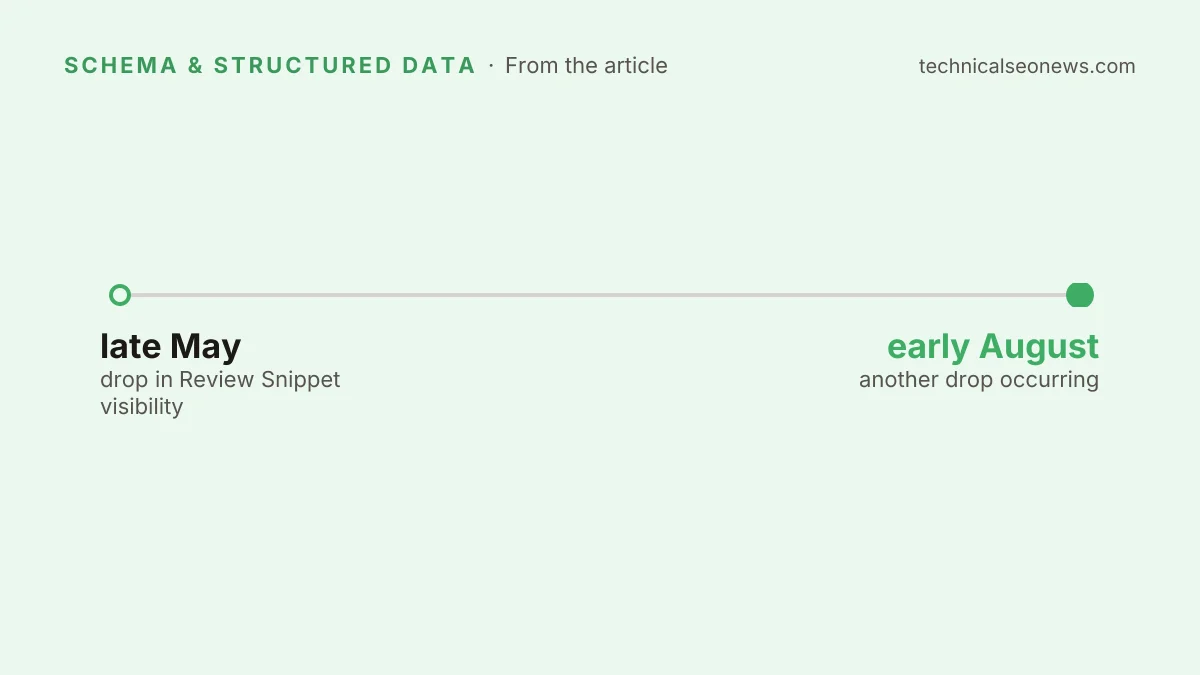
Review stars dropped away from healthcare pages in two stages this year, and reimplementing the markup did not bring them back. Search Engine Roundtable reported on October 7 that Andrea Badder at Schema App, which builds and manages schema markup for large organizations, wrote that “across our healthcare customers, we’ve observed a drop in Review Snippet visibility since late May, with another drop occurring in early August for some organizations.” Badder’s evidence is a Search Console performance chart filtered by search appearance.
Schema App then tried to rule out its own implementation. Its customer success team tested different ways of connecting aggregateRating, alternative property paths, and multi-typing healthcare entities with Product. None of it restored Review Snippet performance, per Badder’s post as quoted by Search Engine Roundtable.
Checking the appearance data before touching the markup is the order worth copying. The search-appearance filter in Search Console’s performance report breaks impressions out by rich result type, which answers a question the Rich Results Test does not: that tool tells you a page’s markup parses and is eligible, not whether Google still shows the result. Valid markup plus zero impressions for the type is not a markup problem.
Google has said nothing about it. Barry Schwartz, who runs Search Engine Roundtable, wrote that he does not see review stars on searches for doctors or dentists outside the local results, and asked whether Google had turned them off for the medical space. A deliberate withdrawal is the likelier explanation than a bug. Two distinct drop dates across Schema App’s healthcare customers, with no recovery from correct markup, is what a feature being switched off looks like. Google removed FAQ rich results outright earlier this year, so a vertical losing one is not a surprise.
Many of Schema App’s healthcare customers declined to keep testing. Badder wrote that many were not interested in changing semantically accurate markup to try to recover the rich result, and that their priority was describing their physicians, locations, services and specialties correctly for search engines and AI systems. That is the right call for a plain reason: rewriting accurate markup to chase a star rating Google appears to have withdrawn costs real engineering time and leaves the schema describing the entity less well than before.
Badder’s reasoning also leans on AI systems, and that part is weaker. Accurate markup is defensible because it is accurate and because Google’s own systems read it, not because it earns citations in AI answers. Ahrefs found no lift in AI citations from adding JSON-LD. Promising a client an AI payoff to replace the lost stars swaps one unmeasured benefit for another.
What to do
- Filter the Search Console performance report by search appearance and isolate the Review Snippet row before changing any code. If impressions fall off a cliff on a single date and your markup did not change that day, the cause is on Google’s side.
- Export that appearance history now. When Google retired FAQ rich results it also cut their Search Console reporting, so the record of what you used to earn may not stay available.
- Leave correct
aggregateRatingand review markup in place. There is no known fix, and the paths Schema App tested, including multi-typing a healthcare entity asProduct, both failed and would misdescribe the organization if shipped permanently. - Tell stakeholders the stars are gone rather than pending. A bug ticket against your own markup will consume a sprint and recover nothing.