Schema ROI: where structured data pays off in 2026
Summary
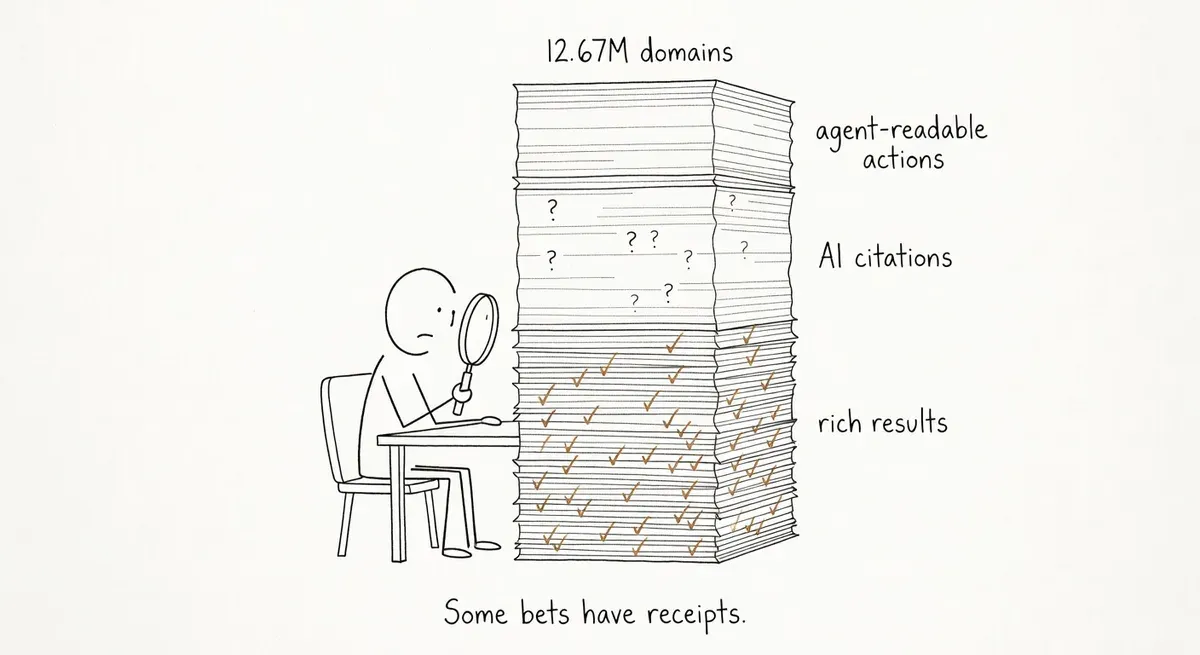
Schema markup does three things in 2026, not one, and the evidence for each is very different. Rich results still pay off. AI citation uplift does not (two studies tested it). And agent-readable markup like BuyAction exists on just 937 of 12.67M domains. We ran the numbers.
We ran a BigQuery study on the HTTP Archive April 2026 crawl covering 12.67 million domains. One number stood out: 224,719 domains tell machines “this is a product” via Product schema. Just 937 tell machines “you can buy it here” via BuyAction. That is a 240:1 ratio between describing what you sell and enabling a purchase, at the exact moment browser agents from Google, OpenAI, and Anthropic are shipping to consumers.
That gap captures a broader problem. The market treats schema as one investment with one return, when it is actually three distinct functions with very different evidence behind each.
- Display: getting rich results in search. Types like Product, JobPosting, and Recipe still deliver measurable CTR lifts. The pruning hit FAQ and HowTo, not the types that perform.
- Comprehension: helping machines understand your content. Organization for brand identity, Person for authors, FAQPage for page structure. Two independent studies found this does not increase AI citations.
- Action: letting AI agents interact with your site. BuyAction for purchases, OrderAction for reservations, potentialAction for signups. Near-zero adoption, near-zero competition.
Vendors promising “schema for AI visibility” are conflating comprehension with citation. Teams stripping deprecated types are throwing away comprehension signals. And almost nobody is building for agents. This piece separates the three functions, shows what the data supports for each, and gives you a decision framework.
Display ROI: rich results still deliver (on fewer types)
Google has pruned aggressively. FAQ rich results disappeared in May 2026. HowTo went in August 2023. Seven lesser-used types (Book Actions, Course Info, Claim Review, Estimated Salary, Learning Video, Special Announcement, Vehicle Listing) were cut in June 2025.
The pruning concentrated on types that were abused or low-value. The remaining types are the ones that actually perform: Product, Review/AggregateRating, Recipe, Video, Article, Organization, LocalBusiness, BreadcrumbList, Event, and JobPosting.
CTR lifts from rich results vary by type and vertical, but the case studies that exist show significant gains. But the standout is JobPosting, which rarely gets the attention it deserves. Google’s case study with ZipRecruiter documented a 4.5x conversion rate increase on job pages after implementing JobPosting markup. Baptist Health reported a 1,194% CTR increase when job posting rich results appeared.
Those numbers dwarf every other schema type, and JobPosting almost never appears in AI-era schema articles.
The biggest untapped ROI is not adding new types. It is fixing broken existing markup.
A Digital Applied audit of 5,000 sites found 71% deploy some form of structured data, but only 22% validate without errors. That 49-point gap between deployed and validated is the cheapest fix in all of schema SEO. Running your top templates through Google’s Rich Results Test costs nothing and often reveals broken types that have been silently failing for months.
The same Digital Applied audit broke down adoption by platform. Shopify sites run 89% Product schema but only 31% pair it with Organization. WordPress sites hit 78% schema adoption via plugins, though much of it is auto-generated and poorly validated. Custom HTML sites show just 19% adoption, but the highest per-instance validity because those implementations tend to be deliberate.
Comprehension ROI: machines understand you better (but don’t cite you more)
This is where the market gets it wrong most often.
Schema does help machines understand your content. That is well documented. Google’s structured data documentation states that “structured data gives an advantage in search results.” Microsoft’s Fabrice Canel confirmed at SMX Munich in March 2025 that “schema markup helps Microsoft’s LLMs understand content for Copilot.” A Nature Communications study (February 2024) demonstrated that LLMs extract information more accurately from structured input compared to unstructured text.
Google appears to still use FAQ structured data for page understanding even after killing the rich result. The evidence is indirect but consistent. The HTTP Archive Web Almanac 2024 shows FAQPage adoption actually increased from 0.2% to 0.6% after the initial deprecation signals. Site owners kept it because it still does something, even without the SERP feature.
But comprehension is not citation. Two independent studies tested whether schema increases AI citations, and both found nothing.
Ahrefs studied 1,885 pages over 8 months (August 2025 through March 2026) and measured citation rates across AI Overviews, AI Mode, and ChatGPT. The results: AI Overviews showed a -4.6% citation rate for pages with schema (statistically significant in the wrong direction), and ChatGPT showed +2.2% (not statistically significant). No citation boost anywhere.
Search/Atlas (December 2024) found no correlation between schema coverage and citation rates in AI-generated answers.
No peer-reviewed studies exist on schema’s impact on AI citation rates. The evidence we have, from two of the more rigorous observational studies in the space, says it does not help.
The reconciliation is straightforward. Schema helps machines understand what your content is about. It does not make them choose your content as a source. Understanding and citation are different functions, and practitioners who invest in schema expecting citation uplift are spending against a hypothesis the data does not support.
Invest in schema for comprehension when you need entity disambiguation (your brand name overlaps with a common word), Knowledge Graph accuracy (Google’s Knowledge Panel shows wrong information), or correct brand representation across AI systems. Do not invest in schema because a vendor told you it would boost your AI visibility.
Action ROI: agents need interfaces, almost nobody is building them
Browser agents shipped in Q1 2026 across major platforms. Perplexity Comet, OpenAI Atlas, and Claude Cowork are all live. WebMCP landed in Chrome 146 Canary in February 2026, exposing structured tools for AI agents directly in the browser.
Microsoft Copilot in Edge prefers schema.org markup for interaction. Google’s web.dev guidance explicitly tells developers to build agent-friendly websites.
The infrastructure is here. The adoption is not.
Our HTTP Archive study (12.67M domains, April 2026 crawl, @type extraction via regex on JSON-LD in httparchive.crawl.pages) quantifies the gap. The 240:1 Product-to-BuyAction ratio from the opening is just the start. Commerce action types combined (BuyAction + OrderAction + ReserveAction) total 36,784 domains, still just 0.29% of the crawl.
SearchAction is the most common action type at 4.14 million domains, but that is almost entirely the sitelinks search box, and Google is removing support for that feature.
Beyond SearchAction and ReadAction (which are passive), the transactional action types barely register:
| Action type | Domains | % of crawl |
|---|---|---|
| ReserveAction | 20,206 | 0.16% |
| OrderAction | 15,641 | 0.12% |
| BuyAction | 937 | 0.007% |
| RegisterAction | 597 | 0.005% |
| SubscribeAction | 294 | 0.002% |
No study measures action schema ROI. The data is simply too thin. But the market conditions are unambiguous: agents are live and multiplying, they need machine-readable interfaces to interact with websites, and the current adoption rate for transactional action types is functionally zero.
This is a positioning bet, not a proven return. Treat it honestly. Adding BuyAction or OrderAction to your top product templates is a low-cost experiment (the markup itself takes hours, not weeks).
If agents start routing purchases through structured action endpoints, sites with that markup will have a head start. If they don’t, you lost a few hours.
The risk is asymmetric in the right direction.
Where to invest: a decision framework
The right schema investment depends on your business type and what you are trying to achieve. Not every site needs every type.
| Situation | Priority investment | Why |
|---|---|---|
| E-commerce | Display (Product, Review) + Action (BuyAction, potentialAction) | Product rich results have proven CTR lifts. BuyAction positions you for agent commerce at near-zero competition. |
| Publishers | Display (Article, NewsArticle) + Comprehension (Organization, Person for author entities) | Article markup drives SERP features. Author entities improve Knowledge Graph accuracy and help Google associate content with known authors. |
| SaaS / B2B | Comprehension (Organization, WebSite) + Action (potentialAction for demos and signups) | No dominant display type for SaaS. Focus on entity clarity and agent-accessible conversion actions. |
| Job boards / HR | Display (JobPosting) | Highest measured ROI of any schema type (4.5x conversions, 1,194% CTR lift). Nothing else comes close. |
| Local business | Display (LocalBusiness, Event) | Direct SERP presence. Event markup is underused for local businesses that run promotions or classes. |
| Everyone | Validate what you have | The 49-point gap between deployment (71%) and validation (22%) is the cheapest fix. Start here. |
For every category, the first step is the same: audit your existing markup before adding new types. Most sites have broken or incomplete schema that generates no value. Fixing it costs less than deploying new types and often delivers faster results.
Schema ROI is real, but only when you measure the right function. Rich results deliver proven CTR lifts on a narrowing set of types. Comprehension helps machines parse your content, though it will not get you cited more by AI systems. Action schema is wide open with near-zero adoption, and the agent infrastructure that would make it valuable is already live.
The practitioner’s first move is almost always the same: validate what you already have deployed. The 49-point gap between sites that have schema and sites that have working schema is free money on the table.
After validation, invest based on your business type using the framework above. Resist the temptation to chase AI citation uplift through schema. Two independent studies tested that hypothesis, and neither found evidence. The market will catch up to this reality, but in the meantime, you can avoid spending against it.
The action schema opportunity is speculative but asymmetric. A few hours of implementation costs almost nothing. If agents start routing transactions through structured endpoints, you will have first-mover positioning. If they don’t, you lost a small experiment. The 240:1 ratio between Product and BuyAction will not stay that wide forever.