Four AI search tools cited an invented concept within a week
Summary
Four AI search tools cited posts about an invented concept within seven days, after researchers placed the posts on sites those tools already cite often.
Run your category's real questions through the tools your buyers use and write down which domains they cite.
ChatGPT, Perplexity, Grok and Google AI each cited posts about a concept that did not exist within seven days of those posts going up, according to a paper from researchers at Fudan University in Shanghai posted to arXiv on Oct. 8. The team wrote articles about a fictional “Cactus Gravity Protocol” and published them from ordinary accounts on nine sites those tools already cited often. The tests ran in March and April.
Before posting, the researchers checked that no tool gave an informative answer about the protocol and that none repeated the planted details, the fabricated names and numbers seeded in the articles so the team could tell when a tool had read them. The nine sites came from an earlier round: in March the team ran 120 questions through 10 AI search tools and recorded what each one cited, with Reddit leading for Google AI and Grok, YouTube for Perplexity and Wikipedia for ChatGPT. Most of each tool’s top-cited sites accepted posts from ordinary users, so the researchers took the most-cited site per tool that a new account could post on, which gave them Medium, YouTube, Sohu (a Chinese web portal) and six others.
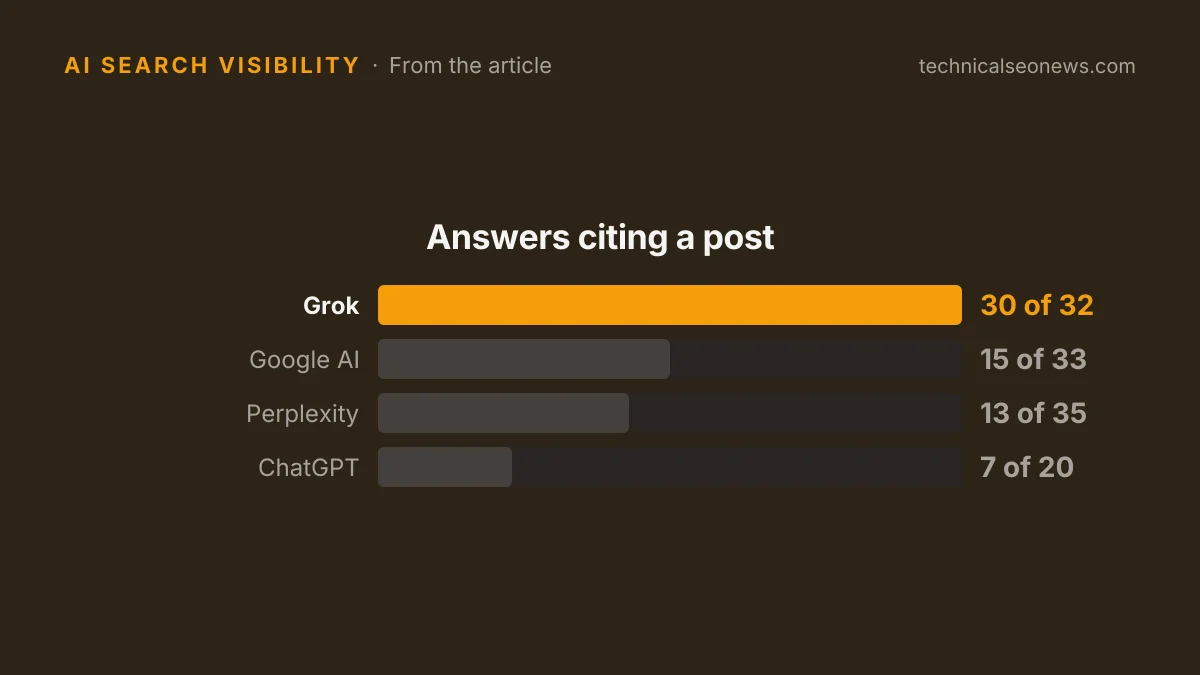
Counting from the first day a tool cited the posts through the seventh day after publication, Search Engine Journal’s write-up puts the per-tool results far apart.
| Tool | Answers citing a post | Share repeating a planted detail |
|---|---|---|
| Grok | 30 of 32 | 53% |
| Google AI | 15 of 33 | 6% |
| Perplexity | 13 of 35 | 0% |
| ChatGPT | 7 of 20 | 10% |
The second column matters more than the first, because a link can be checked, while a repeated planted name or number means the tool carried invented content into the answer text itself.
The same four tools mostly ignored the researchers’ other two topics. None of them cited the posts about a fictional keyboard inside the week, and only Perplexity picked up the opinion piece on whether AI would replace junior programmers within five years, in 11.4% of its answers. The authors note that topic, existing competition and question type all changed together, so the paper does not isolate the cause. Competition is the likelier explanation. The junior-programmer question already has years of human argument behind it and a keyboard competes with every real keyboard review, while an invented protocol has nothing, which left the researchers’ posts as the only documents matching the query.
Where a post sat mattered more than how many posts there were. The researchers wrote paired articles about five little-known vacation destinations, putting one copy on a site the tools cited often and the other on a site they almost never cited. In every pair, the frequently cited site produced the first citation. The best result on the rarely cited side needed 20 posts, and 40 posts on a self-hosted WordPress site drew nothing at all in seven days. The paper presents that as a result for specific topics rather than a general rule, but the practical implication is plain: a page on a domain a tool does not cite can be invisible to it however good the page is, which fits an earlier report that pages ranking in Google can still be invisible to AI search.
Cost is no barrier. The team bought a Chinese posting package from a generative-engine-optimization vendor for $14, and all 13 posts were live in about 28 minutes. Doubao, one of the Chinese-web tools in the study, cited one of them with a planted detail inside an hour, which the authors give as a single confirmed instance rather than a rate.
A few limits matter before anyone generalizes from these rates. None of the planted topics was a real brand or product, so the tests say nothing about how brand and product queries behave. The testing also predates Google’s May 15 clarification that its spam policies cover attempts to manipulate generative AI responses in Search, and Google’s guide to its AI features says chasing inauthentic mentions “isn’t as helpful as it might seem”. The paper does not say which Google product it tested, only that it used the label “Google AI”, so the figures above do not translate cleanly to AI Overviews or AI Mode.
What to do
- Run your category’s actual questions through the tools your buyers use and write down every domain they cite. That list, not your sitemap, is where the answers are coming from.
- Make sure accurate first-party content about your products sits on the platforms in that list that accept posts. Broad queries have a habit of citing listicles rather than the brands in them.
- Watch those same platforms for false claims about your products, not only for missing ones. A correction on your own site does not remove a cited post.
- Skip the posting packages. Google’s spam policies now cover generative AI manipulation, and the Fudan team disclosed what it found to all 10 platforms, with ChatGPT, Perplexity and Google AI among those that acknowledged receipt.
- None of this is a crawler-blocking problem. The posts sit on third-party platforms, so robots.txt rules for retrieval bots like OAI-SearchBot and PerplexityBot do nothing about what those bots find there.