Google's free audit tells AI agents what to fix in your repo
Summary
Google released Modern Web Guidance 1.0, a free skill set for AI coding agents, and it now audits a project's existing HTML, CSS, JavaScript and package.json and hands the agent the changes to make.
Run the audit on your own repo and read what it proposes before an agent is allowed to commit it.
Google released version 1.0 of Modern Web Guidance, a free skill set that teaches AI coding agents current browser practice, and this version adds an audit of code already in the repo. Per Search Engine Journal’s report, Philip Walton, a senior staff developer relations engineer at Google, announced the release in a Chrome for Developers post, with Firefox and Edge joining the project.
The audit reads a project’s HTML, CSS and JavaScript files along with its package.json, picks out places where the code can safely be updated, and then walks the agent through the changes. One command in the project directory installs it:
npx modern-web-guidance@latest installThe project repository is public, and the skills also ship through the plugin marketplaces of most popular coding agents. Anyone still on the preview Chrome showed at Google I/O in May updates with npx modern-web-guidance@latest update.
Three categories keep failing in Google’s own tests of current coding models: accessibility, security headers, and loading priority for scripts and images. That last one reaches Core Web Vitals reports, and note inc. A Japanese creator platform, put a number on it. The platform ran two coding agents through six interface tasks across 180 test runs on clones of its production codebase. One task checked whether the largest image on an article page got high priority and stayed out of lazy loading. Unguided agents wrote hero image code that was high priority and lazy-loaded at the same time, according to the comparison table in Chrome’s write-up of the test.
Those two attributes work against each other, and a reviewer skimming a diff for layout changes has no reason to stop on either one. Google now renders almost every page before it indexes it, so markup an agent wrote is markup that gets measured.
The agents in note’s test improved once the skill was installed without being named in prompts, then improved again once prompts named it. The figures are the share of 19 browser checks each agent passed:
| Agent | No guidance | Installed, not named | Named in prompt |
|---|---|---|---|
| Agent One | 60.8% | 76.5% | 94.0% |
| Agent Two | 75.8% | 86.2% | 90.0% |
Installing the skill and using it are not the same thing. The gap between the last two columns is the part a team controls through its own prompt templates.
Where the audit stops
The first version of the audit is static analysis across a limited number of code patterns, and Google says later versions should have the agent reason about the code it is auditing. For now the output is a proposal, not a verdict. Adrian Roselli, an accessibility consultant, tested the May preview by giving Antigravity, Google’s AI coding tool, an animated accordion prompt lifted from the documentation. Per SEJ’s account the result did not comply with WCAG and the animation did not work in Firefox, and Roselli found nothing that guaranteed an agent would follow the guides at all. That was the preview, not 1.0, but the guides are still context handed to a model, not a linter that fails a build.
MetaMask, which makes a crypto wallet browser extension, runs the guidance as an automatic review on every pull request to that extension. Through Oct. 21 the bot raised 102 issues across 57 pull requests. Engineers fully resolved 43 of them. Another 16 were declined or false positives, and 20 were never addressed. Some share of what the bot raises is noise, which is the argument for a person reading the audit before an agent acts on it.
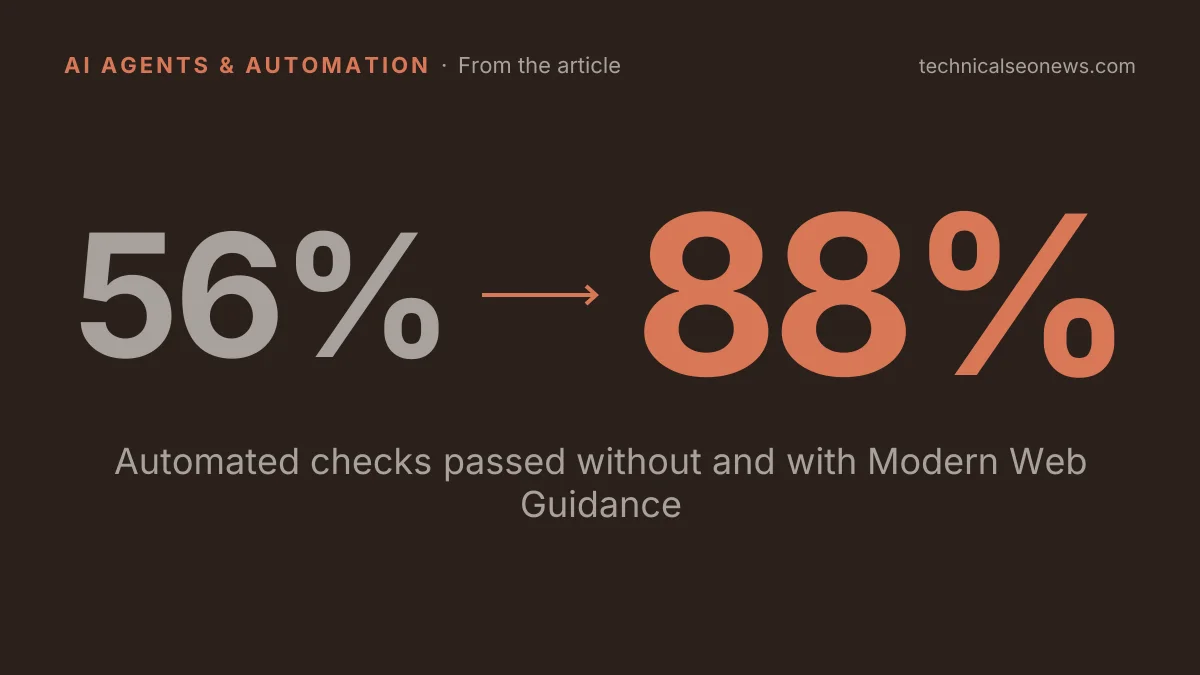
Google’s announcement links to a public dashboard where coding agents from Anthropic, OpenAI and Google repeat the same tasks nightly, with and without the guidance, and a real browser checks the result. Search Engine Journal’s writer found guided runs passing 88% of the automated checks against 56% for unguided runs on the Nov. 8 nightlies. Guided runs were also slower and burned more tokens in most of the recent suites.
The governance document that landed in the GitHub repo on Nov. 9 sets six owner seats. Chrome holds two, and Edge and Mozilla hold one each. Independent web platform experts hold the other two, and no seat belongs to Apple. SEJ’s piece does not draw this line, but the guides encode what Chrome, Edge and Mozilla agree is current, which makes Safari-specific behaviour the likeliest thing to go unrepresented.
What to do
- Run the audit on a branch of your own front-end repo and read the proposed changes yourself before any agent has permission to commit them. Static analysis over a limited pattern set will both miss real problems and flag code that is fine.
- Name the guidance in your prompt templates rather than relying on the install. Both of note’s agents scored higher once prompts named it.
- Check the hero image on any template an agent has touched: the largest image in view should carry high fetch priority and should not be lazy-loaded.
- Pair the guidance with Chrome DevTools for agents, which Google suggests so the agent can run its own output and test it in a browser.
- Keep field data and manual accessibility testing in the review rather than trusting a pass rate. Lab numbers move for reasons that have nothing to do with your code, as when PageSpeed Insights scores rose on pages nobody touched.