Agentic search drops sites lacking extractable claims
Summary
A practitioner tested Google's agentic search on home service queries and found the system filters out businesses post-ranking when pages lack specific, extractable claims (pricing, service areas, hours).
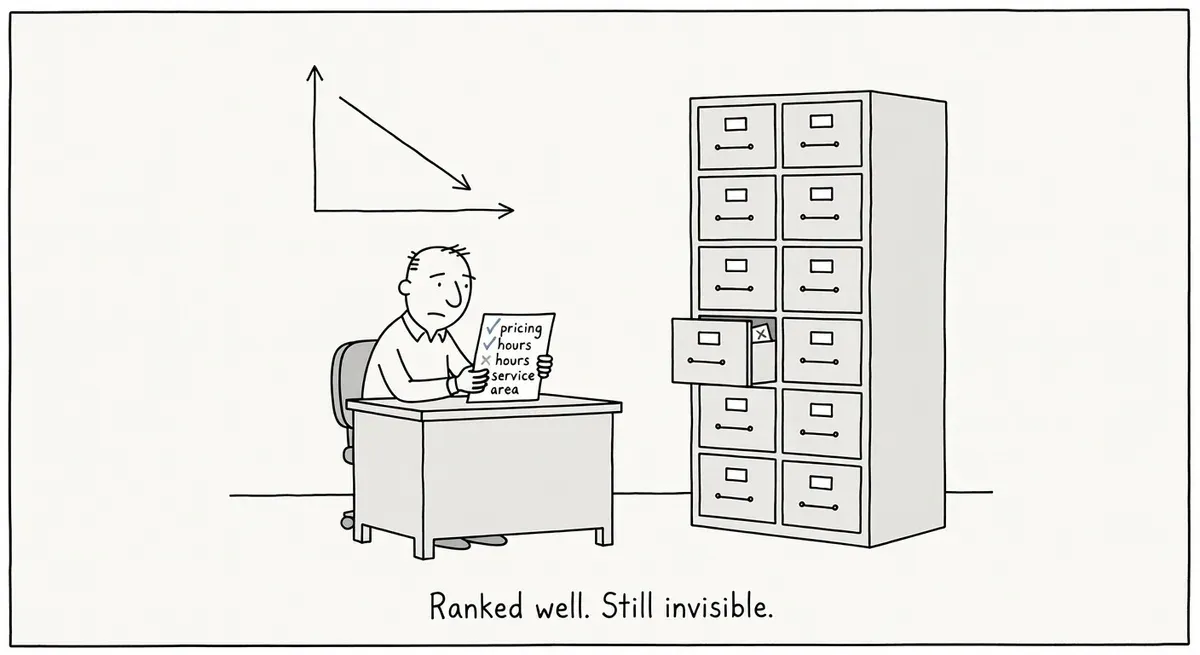
Sites that rank well can still be dropped during agent narrowing if the content doesn't match user constraints.
The testing is limited to local/home services, so applicability to other verticals is unconfirmed.
What happened
Google rolled out a more agentic version of Search that narrows recommendations based on user requirements, explains why a business fits, and in some cases offers to call on the user’s behalf. A practitioner testing the feature on home service clients shared findings in r/TechSEO reporting that the system actively filters businesses out of results when their sites lack specific, extractable claims.
The practitioner found that generic positioning got dropped during filtering. Specific claims like “manual calculations,” “fixed price quotes with no hidden fees,” and “same-day service” were the kinds of details the agent kept and used. The system continued filtering even after a business had been initially cited.
When the agent moved toward booking intent, conversion paths mattered too. Sometimes it surfaced the right service page. Other times it pushed users toward a generic contact page, breaking the booking flow.
Why it matters
Testing suggests agentic search functions as a second gate after initial ranking: constraint-based filtering against the user’s actual requirements (budget, timeline, service type). A site ranked number one can still be removed if the agent can’t extract claims that match what the user asked for.
Consider a roofing contractor whose service page lists “inspection, repair, replacement” but provides no pricing anchors. When a user filters by budget, the agent can’t validate whether that contractor fits. A competitor with clear pricing tiers (“$2K-$4K for small repairs, $8K+ for full replacement”) stays in the narrowed set.
The same applies to geographic coverage. A home cleaner with vague “serving the metro area” language may lose out to a competitor with explicit ZIP code service areas. The agent needs content specificity to match user constraints: both natural-language text, which LLM-based agents parse directly, and structured data, which provides explicit, unambiguous entity attributes.
The practitioner’s testing also revealed that agents choose which page to land users on. The agent picks the page it thinks best matches the user’s stated intent, not necessarily the page you’ve built the most authority to. Dedicated service pages with specific claims have always been good practice, but now there’s a mechanism that actively enforces it.
What to do
Start by auditing your service pages for extractable claims. Every page should answer these questions in plain, crawlable text: What specific services do you offer? What don’t you do? What areas do you cover? What are your hours? What pricing model do you use? The agent needs to pull these details directly from page content.
Implement LocalBusiness structured data with complete properties. OpeningHoursSpecification and areaServed with explicit geographic boundaries give the agent structured fields to filter against. For pricing, priceRange on the LocalBusiness entity provides a general indication, but for granular per-service pricing, attach Offer or AggregateOffer markup with explicit price and priceCurrency values to individual Service entities via makesOffer. The schema.org LocalBusiness documentation covers both native and inherited properties across the full type hierarchy.
An Ahrefs analysis found JSON-LD schema didn’t boost AI citation frequency in AI Overviews and ChatGPT. That study measured citation, not the constraint-filtering behavior described here. Schema helps agents validate claims when they’re already considering you, not necessarily get you considered in the first place.
Review your site’s information architecture from the agent’s perspective. Each service type should have its own page with specific claims, pricing context, and a clear conversion action. If the agent can only find a generic contact page, it will send users there instead of to the service-specific page that would convert better.
Check for contradictory claims across your site. If one page says “24/7 emergency service” and your Google Business Profile shows 9am–5pm hours, the inconsistency could confuse the agent’s entity understanding and reduce confidence in extracted claims. Consistency across all touchpoints matters more now.
Watch out for
Agent filtering happens after ranking. Traditional rank tracking won’t tell you whether you survived the narrowing step. You can rank well and still be absent from the agent’s final recommendation. As of this writing, we’re not aware of widely available rank-tracking tools that reliably monitor agentic result inclusion, so manual spot-checking of constraint-heavy queries is the most practical starting point while tool support catches up.
False specificity backfires. Claiming “same-day service” or “fixed pricing” without backend systems to deliver on those promises creates a new kind of risk. The practitioner’s testing showed agents may attempt to call or book on the user’s behalf. If the claim doesn’t hold up during that interaction, the failure is immediate and visible.
Vague service areas get skipped. When a user specifies a location, the agent needs to verify coverage. “Serving the greater metro area” is not parseable. Explicit ZIP codes, city names, or radius definitions in both page content and structured data give the agent something to match against.