AI search may read only a couple hundred words of your page
Summary
Ranking well does not decide what an AI answer says about a page. The model writes from a few extracted passages, and tests suggest a long page gets a smaller share of itself through than a short one.
Check what AI answers say about your brand before changing anything. Rewrite only where they misrepresent you, and make each section dense enough to stand on its own.
AI search tools do not give the language model a whole page. They score individual passages, extract the best ones, and the model writes its answer from those. The page’s owner has no say in which passages make it through. Dan Petrovic, founder of the agency DEJAN, walked through the steps in a webinar hosted by Sitebulb, which makes an SEO crawler. Sitebulb published a recap of the webinar on February 9, 2026.
From prompt to citation
Petrovic described four steps between a prompt typed into Google’s AI Mode or ChatGPT and the citations the user sees:
- Reformulation. The system rewrites the prompt into several synthetic search queries, anywhere from two to six, and each one returns its own set of results.
- Shortlisting. Several hundred results are cut down to a few in a reranking pass.
- Passage scoring. For each shortlisted page, the system reads its cached copy and scores individual passages against the query with a cross-encoder, a model that reads the query and a passage together and rates how well they match.
- Grounding snippet. The top passages are pulled into a grounding snippet, which goes into the model’s context alongside the rewritten queries.
The model then writes the answer, carrying whatever biases it picked up in training. Every follow-up message in the chat runs the whole loop again. Google has described the first step in its own words: AI search splits long questions into smaller queries.
Where control is lost
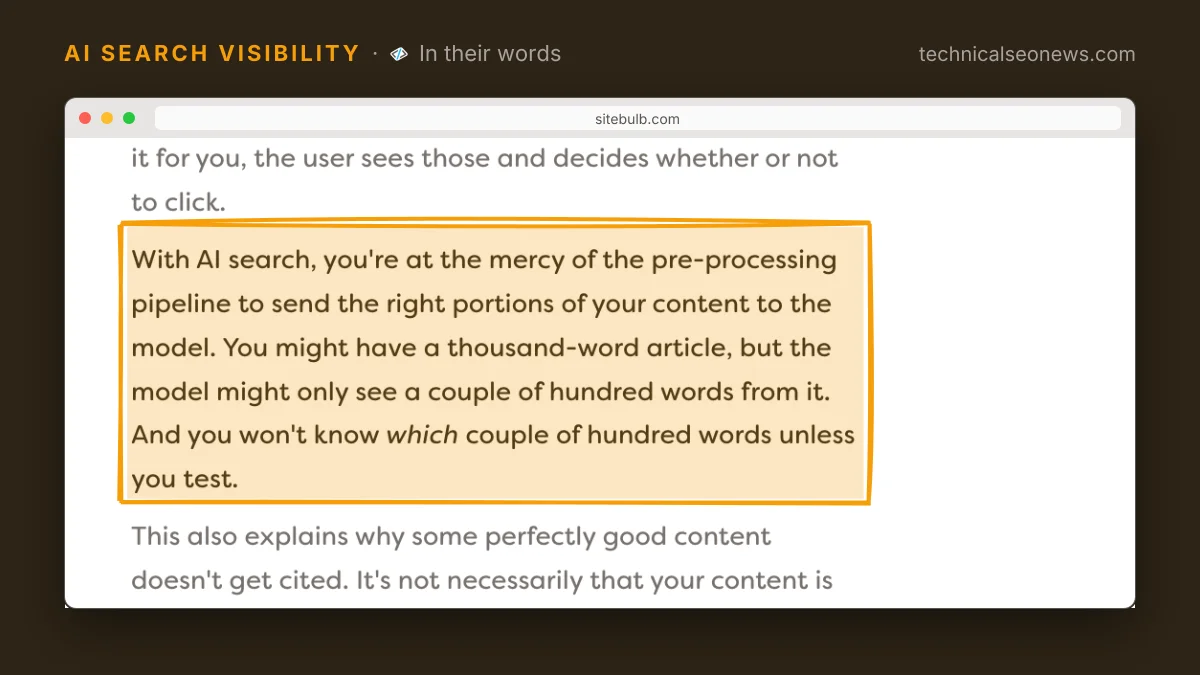
Classic search lets a site write the words the searcher sees. The title tag and meta description reach the results page as written unless Google rewrites them. In AI search, the retrieval steps decide which parts of the page the model reads. Petrovic’s example is a thousand-word article that might contribute only a couple of hundred words, and nobody knows which ones without testing.
A page can rank well and still go uncited for that reason. The page is not necessarily weak. The wrong passages may simply have ended up in the grounding snippet.
Petrovic’s tests also suggest a practical ceiling on how much of any one page reaches the model, now known as the grounding budget. Google has not confirmed any such mechanism. If the ceiling exists, a larger share of a 1,000-word article gets through than of a 10,000-word guide.
Shorter is not the fix
Sitebulb’s recap stresses that the answer is not to cut pages down. Google builds snippets with extractive summarization, which selects existing sentences rather than writing new ones, and it is good at finding the relevant passage inside a long page. The question that matters is whether the passages it picks describe the brand and product accurately.
Petrovic also tested how people read. A survey asked people whether they read or skim, while a script tracked what they actually did on the page. Everyone spent about two minutes, whatever they claimed about themselves. Petrovic argues that people and AI systems pay attention in similar ways: the top and bottom of a page get read, the middle gets lost, and both struggle with pages that are mostly filler.
What to do
- Measure before editing. Petrovic’s advice in the recap is to “do nothing and just measure what’s happening in the AI search to see if you are misrepresented, and act on it only if you have a problem.” Run the prompts your customers would ask in AI Mode and ChatGPT, and compare what the answers say about you with what your pages say.
- Fix structure only where answers go wrong. When AI answers keep quoting the wrong section, make every section carry a real point under a clear heading, so any passage the cross-encoder picks is representative.
- Keep key claims out of the middle. Put the facts you most want repeated near the top of the page or of each section, not buried in a long middle stretch.
- Do not trim long guides by reflex. Cut filler instead of depth. A long page with dense sections still gives the extractor good passages to choose from.
- Wait for a recrawl before judging a rewrite. Passage scoring reads a cached copy, so old passages can keep being scored until the search crawler fetches the page again. The recap does not name the crawlers. For AI Mode it is Googlebot, and for ChatGPT search it is OpenAI’s OAI-SearchBot; check server logs for that fetch. Training crawlers such as GPTBot play no part in this retrieval path.