Google's AI search splits long questions into smaller searches
Summary
Google's head of Search says people now type their whole problem into AI Mode as one long question, and Google has to break it into parts. Search Engine Journal argues each part runs as an ordinary search, so classic rankings for short queries still decide which pages the AI answer uses.
Writing pages for one-off long prompts is a poor use of time. The better target is the handful of specific needs inside those questions, and where you rank for each.
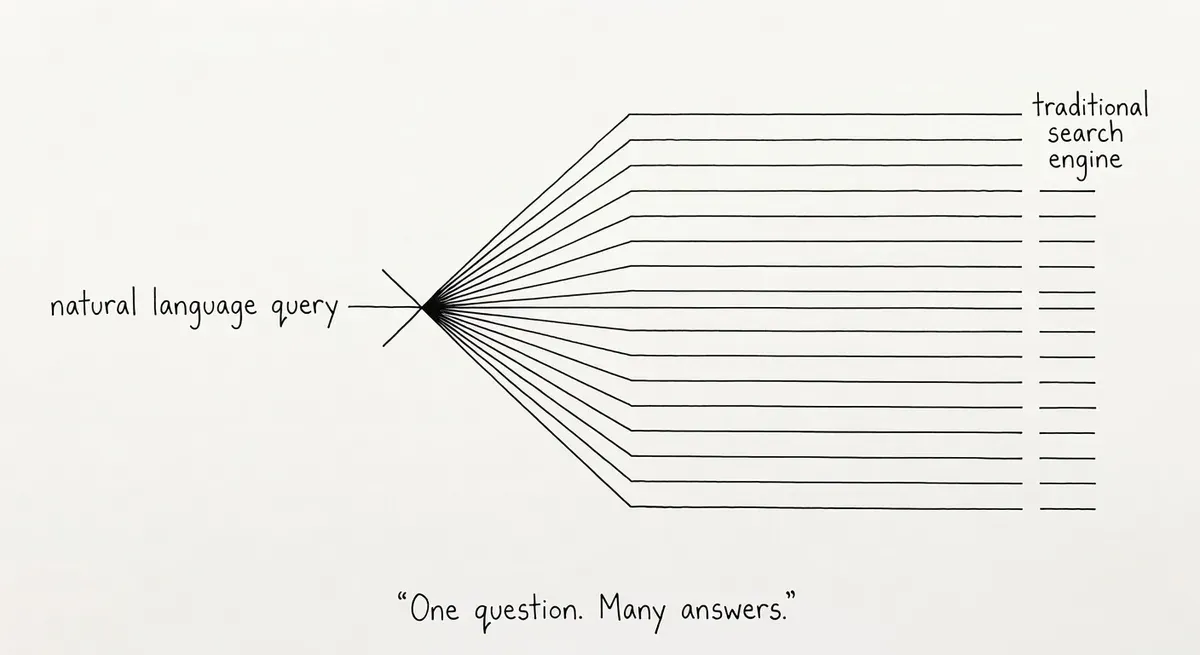
Liz Reid, who runs Google Search, said on Bloomberg’s Odd Lots podcast that people using AI Overviews and AI Mode type “meaningfully longer queries” that describe their actual problem, and that Google has to break those questions apart to answer them. Search Engine Journal’s piece on the interview draws the SEO consequence: the long question becomes several short searches run against classic search, so ordinary rankings for those short queries decide which pages feed the AI answer.
What Reid described
Reid used restaurants as her example. People used to type “restaurants New York” when the question in their head was a place in a given location for five people, not too pricey, with one vegan in the group and kids along. That information “would be spread throughout the web,” she said, so nobody trusted a search box with the full question. Now people tell AI Mode the real problem “and expect us to do the translation.” Reid called the translation a harder quality job: “You have to take this question, there’s many parts, and you have to figure out how you break it apart.”
SEJ’s argument
Search Engine Journal (SEJ) ties Reid’s remarks to query fan-out, the process in which Google’s AI turns one long question into several narrower searches. The piece claims those narrower searches go to classic search and that the AI picks from the top three results for each one to write its answer. Reid does not say this in the quoted interview, so the top-three cutoff is best treated as SEJ’s rough guide, not a rule.
From there SEJ concludes that chasing long-tail prompts is mostly wasted effort. Complex questions may be asked once and rarely repeated, and one page is unlikely to answer all of their parts anyway. The pages that show up are the ones that rank for the specific pieces.
The likelier reading, even without the top-three figure, is that each piece of a split question behaves like a query with its own results, and a page has to earn a place in those results to be considered. Keyword research still works. The unit it works on is the component need, not the full sentence a user typed.
Take Reid’s restaurant question as an illustration. A made-up breakdown might produce searches for vegan-friendly restaurants in a neighborhood, kid-friendly restaurants there, and places that seat groups of five. A local guide that ranks well for the vegan search has a shot at the answer. A page written to match the whole question gains nothing if it ranks for none of the parts.
Classic results also still matter on their own. A second SEJ piece on the interview quotes Reid saying that people who go straight to AI Mode tend to ask complex questions with follow-ups, while people with “very browsy” queries, searches where they want to scan options, may prefer the full results page.
What to do
- List the long questions your customers actually ask, then split each into its separate needs: the location, the constraint, the audience, the price. Check where you rank for the short query behind each need.
- Where you rank for none of the pieces, build or fix a page for the piece you can serve best. Do not write a page aimed at the full prompt.
- Answer each need in a section that makes sense on its own. Earlier coverage found that AI search may read only a couple hundred words of a page, so the answer to a sub-query should not depend on the rest of the article.
- Audit pages by the need they fill, not only by keywords, headings, and technical issues. The author of SEJ’s piece describes a site with indexing trouble whose owner suspected a technical fault. The problem showed up once the author asked what need the page filled and how it was different from and better than other pages on the topic.