Bing's AI cited one site 75 times for a query no human would type
Summary
In one site's export from Bing's AI Performance report, the top query Bing's AI ran before citing the site was a phrase no human would type, and it sat behind 75 citations.
Sort the strings by the question each one implies and answer each question under its own heading, since the matching runs on meaning rather than wording.
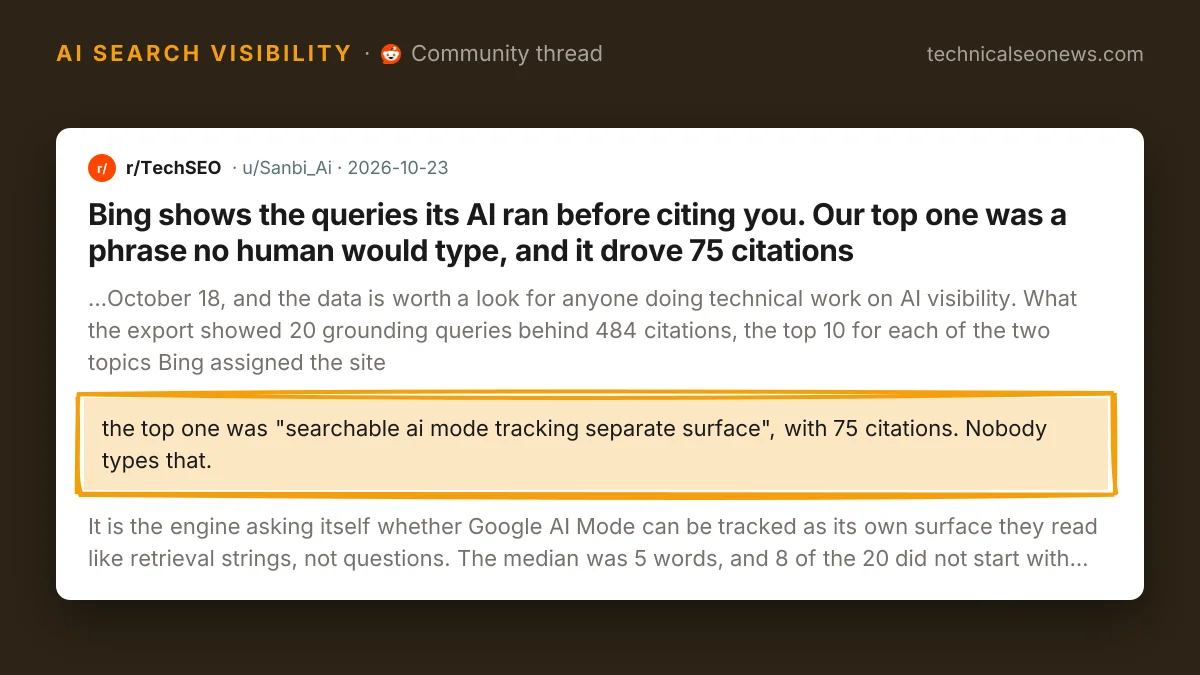
Bing Webmaster Tools’ AI Performance report lists grounding queries, the phrases Bing says its AI used when retrieving the content it then cited. A site owner posting in r/TechSEO published an October 18 export of their own. The top phrase, “searchable ai mode tracking separate surface”, sat behind 75 of 484 citations.
That phrase is not a search anyone ran. The poster reads it as the engine asking itself whether Google AI Mode can be tracked as its own surface, and the other 19 queries in the export look much the same. The median length was five words, and 8 of the 20 did not open with how, what, best, free, top or Google.
One of the 20 was French, “tracker de positionnement chatgpt fonctionnement”, and it matched an English page anyway. A commenter on the thread treated that as the giveaway: if a French string pulls an English page, the matching runs on meaning rather than on words, so writing a page around a guessed grounding phrase buys less than the report seems to promise. The likelier explanation is that these strings are a readout of the retrieval step, with no search volume behind them. Nothing here says what to repeat on the page, and because the export does not record which page was cited, it cannot show whether the top phrase appeared in that page at all.
What the strings are good for
What the poster says works is giving each implied sub-question its own heading, with the answer in the first sentence, so retrieval has a clean passage to lift. Grouping the export by the question behind each string rather than by the string itself is what showed the pattern: best-of lists took 35% of the site’s citations and the AI Mode tracking question 34%. That is the usable unit of work, and it matches what other surfaces show about their own retrieval, where ChatGPT’s fan-out requests split one prompt into separate searches that each name a source and a freshness window.
The same report’s Topics Portfolio beta, added October 13, lists opportunity queries, meaning queries where other sites get cited in a topic Bing has assigned you and you do not. The classifier that feeds it is noisy. The largest of the poster’s 100 opportunity queries was a typo, “ai tool s”, and the topic classifier filed “home sauna highest aeo seo ratings” under the site’s SEO topic.
Bing calls the whole dataset a sample and says to use it directionally. The export records no date window and does not say which page was cited, and it covers only Copilot, Bing’s AI answers and unnamed partners. A citation in it is also not a click.
What to do
- Export the grounding queries from the AI Performance report and sort them by the question each one implies, not by wording. Two or three recurring questions will usually cover most of the citations.
- Give each of those questions its own heading on the relevant page, with the answer in the opening sentence of the section. That is the one change the retrieval behaviour in this export argues for.
- Search your site for your top grounding phrase. If it appears in no heading on the pages that cover that question, matching is running on meaning, and building pages around the literal strings is wasted work.
- Filter the opportunity-query list hard before it reaches a content plan. Drop typos, competitor names and anything the topic classifier clearly misfiled.
Watch out for
Do not treat citation counts as a traffic number. Bing reports citations, which is the retrieval layer saying it used your page, and it says nothing about whether anyone clicked through or saw your name in the answer. One export from one site is also a single observation, and Bing’s own guidance to read the data directionally is the right level of confidence until more practitioners publish theirs.