ChatGPT free and paid users see two different webs
Summary
Writesonic analyzed 1,161 ChatGPT citations and found only 7% source overlap between GPT-5.3 (free) and GPT-5.4 (paid) on identical prompts. Free users get Forbes and TechRadar. Paid users get brand homepages and pricing pages directly, with GPT-5.4 using site: operators in 156 of 423 queries.
Meanwhile, AirOps found 85% of pages ChatGPT retrieves never get cited, and Botify's 7 billion log files show crawler activity tripled while citations shrank.
Your optimization strategy depends on which model your audience uses.
What happened
Five independent studies published between February and May 2026 reveal that ChatGPT operates two fundamentally different search systems depending on subscription tier. Writesonic’s analysis of 1,161 citations across 119 conversations found only 7% source overlap between GPT-5.3 (the free default) and GPT-5.4 (the paid model) on identical prompts.
The difference runs deeper than citation counts. GPT-5.4 decomposes each prompt into multiple sub-queries and uses site: operators in 156 of 423 total queries to search specific brand domains directly. GPT-5.3 sends roughly one broad query and surfaces whatever the search index returns. The result: GPT-5.4 sends 56% of its citations to brand websites, while GPT-5.3 sends 8%.
Separately, AirOps analyzed 15,000 queries and 548,534 retrieved pages. 85% of pages ChatGPT retrieves during research never appear in the final answer. Of the pages that do get cited, 32.9% were discovered only through fan-out sub-queries, not the original search.
Why it matters
Free-tier and paid-tier users see different source ecosystems. In Writesonic’s data, GPT-5.3’s top cited domains were Forbes, TechRadar, Tom’s Guide, and Reddit. GPT-5.4’s were HubSpot, Shopify, and Salesforce.
The divergence extends to how each model uses traditional search results. Among GPT-5.4’s cited domains, 75% did not appear in Google or Bing results for the same prompt. GPT-5.3 overlapped with Google results 47% of the time. The data suggests the paid model builds its own retrieval path while the free model relies more on existing search indexes.
Crawling volume tells a different story than citations. Botify’s analysis of 7 billion log files shows OpenAI’s total crawl tripled since August 2025. But Search Engine Land’s 14-week tracking of 400 daily prompts found unique domains cited per response dropped from 19 to 15 after the GPT-5.3 switch.
Google rankings still influence citation odds. AirOps found a 43.2% citation rate for pages ranking #1 in Google, versus much lower rates outside the top 20. Separately, Ahrefs’ study of 1.4 million prompts found that pages with high title-query semantic similarity get cited at higher rates.
What to do
Identify which ChatGPT tier your audience uses. GPT-5.4 cited pricing pages 35x more often than GPT-5.3 in Writesonic’s test. If your buyers use ChatGPT Plus, optimize your branded pages directly. If your audience skews free-tier, third-party editorial placements on high-authority publishers carry more weight.
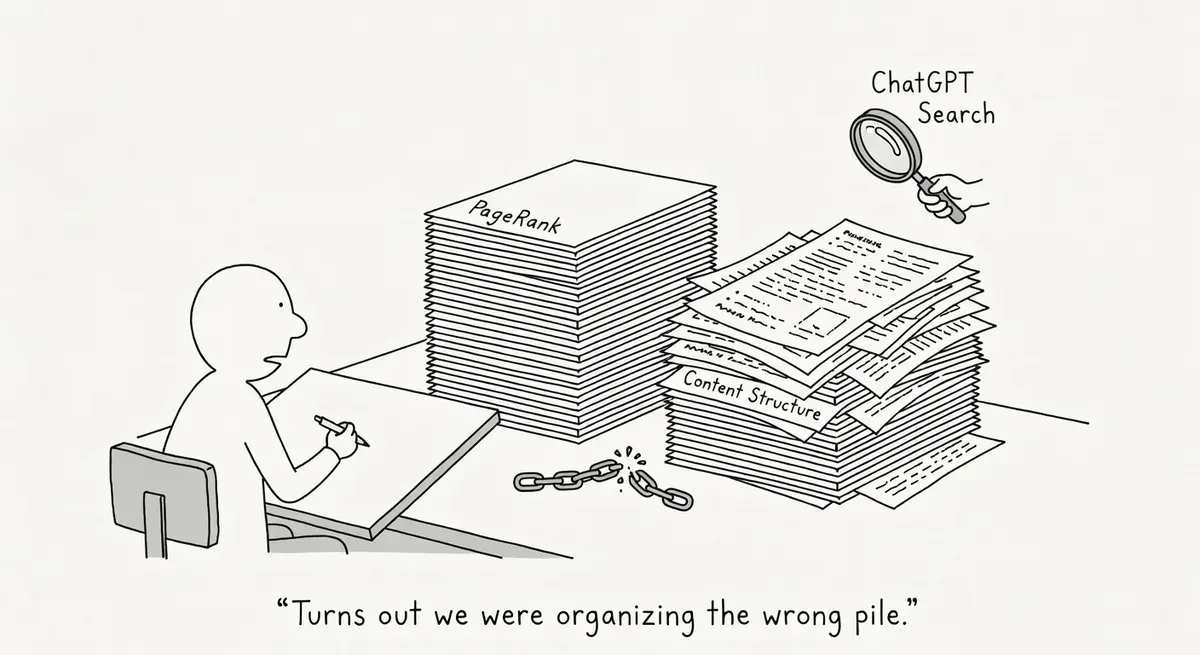
Close the retrieval-to-citation gap. Being fetched by ChatGPT is not enough. Put your clearest answer in the first paragraph, not after a lengthy introduction. AirOps found pages with 50%+ title-query overlap get cited at over twice the rate of low-overlap pages.
Accept that fan-out queries are invisible to traditional tools. AirOps found 95% of ChatGPT’s fan-out queries have zero monthly search volume. Standard keyword tools will not surface them. Instead of targeting specific fan-out keywords, build thorough topical coverage so your pages surface regardless of how the model decomposes a prompt.
Check your server logs for model-specific patterns. OAI-SearchBot (search indexing) and ChatGPT-User (real-time fetches) behave differently. Botify’s data shows OAI-SearchBot surging while ChatGPT-User declined 28% from December 2025 through March 2026. If you see OAI-SearchBot but not ChatGPT-User, your pages may be indexed but not actively cited in answers.
Watch out for
The free-tier default is getting worse for brands. In Writesonic’s study, the previous default model (GPT-5.2) cited brand websites 22% of the time. GPT-5.3 dropped that to 8%. If this trend continues, free-tier citations may concentrate further into a small set of editorial publishers.