A fake Google core update ranked on page one and in AI Overviews
Summary
Google ranked an AI-invented core update on its first page and repeated it in AI Overviews, and other sites copied it with extra invented detail. Google does not fact-check what it ranks, and it is phasing out its one fact-check display in Search, ClaimReview rich results.
Before reporting on an update or changing a site because of one, confirm it on Google's Search Status Dashboard. Treat any named update mechanism missing from Google's documentation as unverified.
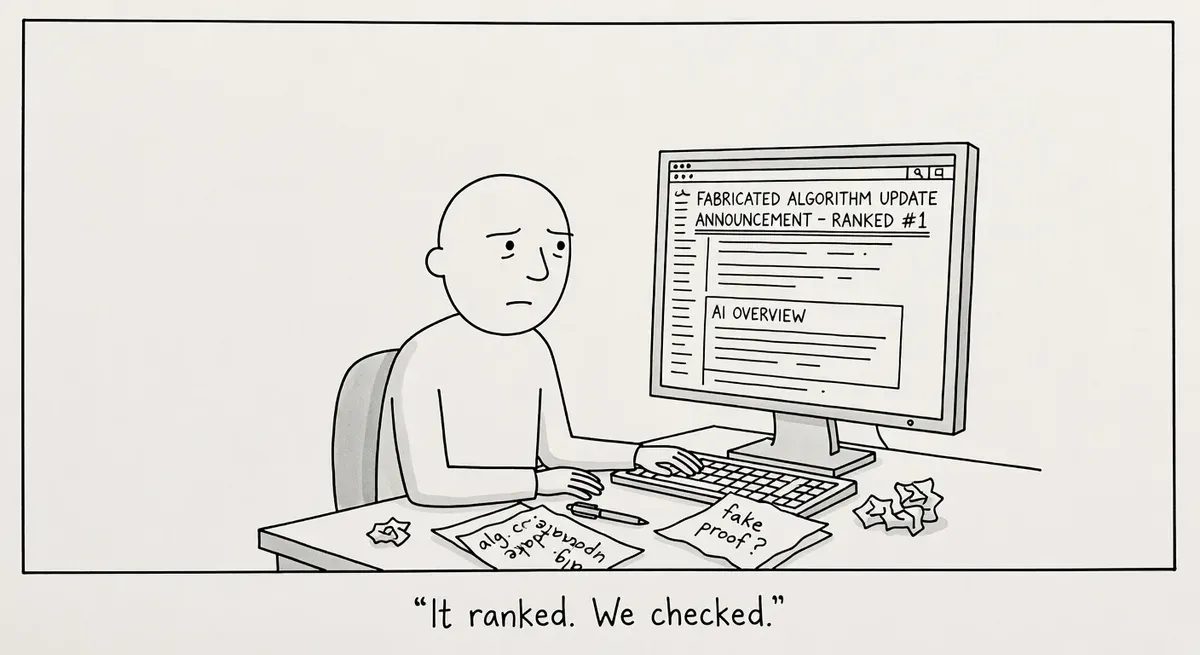
Jon Goodey, an SEO who writes a LinkedIn newsletter with an AI-assisted workflow, published an article about a Google “March 2026 core update” that did not exist. The article ranked on the first page of Google for “Google March update 2026.” Search Engine Journal’s report says Goodey’s own human review step caught the AI hallucination, and he published it anyway to see whether anyone would dispute it. According to Goodey, Google’s AI Overview then picked up the fabricated update and presented it as fact.
Other sites repeated the claim and added details of their own. Goodey says multiple websites published detailed articles treating the update as confirmed, with claims about “Gemini 4.0 Semantic Filters” and “Information Gain metrics.” One, on the technology site TechBytes, ran under the headline “Google March 2026 Core Update: Cracking Down on ‘Agentic Slop’” and invented a “Zero Information Gain” classification system. Search Engine Journal (SEJ) says it and competing SEO publications ignored the story. Goodey reports that only a few commenters challenged the false claims.
Google Search does not fact-check results
Google does not fact-check what it ranks. SEJ’s piece cites an Axios report in which Kent Walker, Google’s global affairs president, told the European Commission that Google would not commit to showing fact-check results alongside Search results or building fact-checking into its ranking systems.
The one fact-check display Search had is on its way out. Google’s ClaimReview documentation describes a rich result that shows a summary of a publisher’s fact check when that page ranks for the claim it reviews. A notice at the top of the same page says Google is phasing out support for ClaimReview markup in Search. Even while it worked, someone had to write the debunk and mark it up, and Google never guaranteed the result would show. For a rumor that circulates only among SEOs, the likelier outcome was always that no debunk would sit beside the fabricated page.
A real update later took the same name
Google’s Search Status Dashboard shows that the last core update before the fake one was in December 2025. SEJ published its report on 18 March 2026. A real March 2026 core update began on 27 March, so the fabricated articles now carry the same name as a real rollout. The likelier consequence is that readers take their invented filters and classification systems as analysis of the real update.
What to do
- Confirm any update on the Search Status Dashboard before writing about it or changing a site in response. Google lists confirmed ranking updates there with start dates and durations. Check publication dates as well: coverage of a “March 2026 core update” published before 27 March describes something that had not happened.
- Treat named update mechanisms as unconfirmed until Google documents them. Terms like “Gemini 4.0 Semantic Filter” spread by sites copying each other, not by anyone citing Google.
- Keep a human check in any AI writing workflow and point it at claims about Google. Goodey’s review caught the hallucination; the search results and most readers did not.