Google opens Search to developer apps, but users must add them
Summary
Google's Connected Apps Platform preview lets developers put an app's functions inside Google Search and the Gemini app, but a searcher has to add an app before it can appear for them.
The useful first step is deciding who inside the company owns that MCP endpoint, because the same owner chooses whether the app ships to Search, Gemini or both.
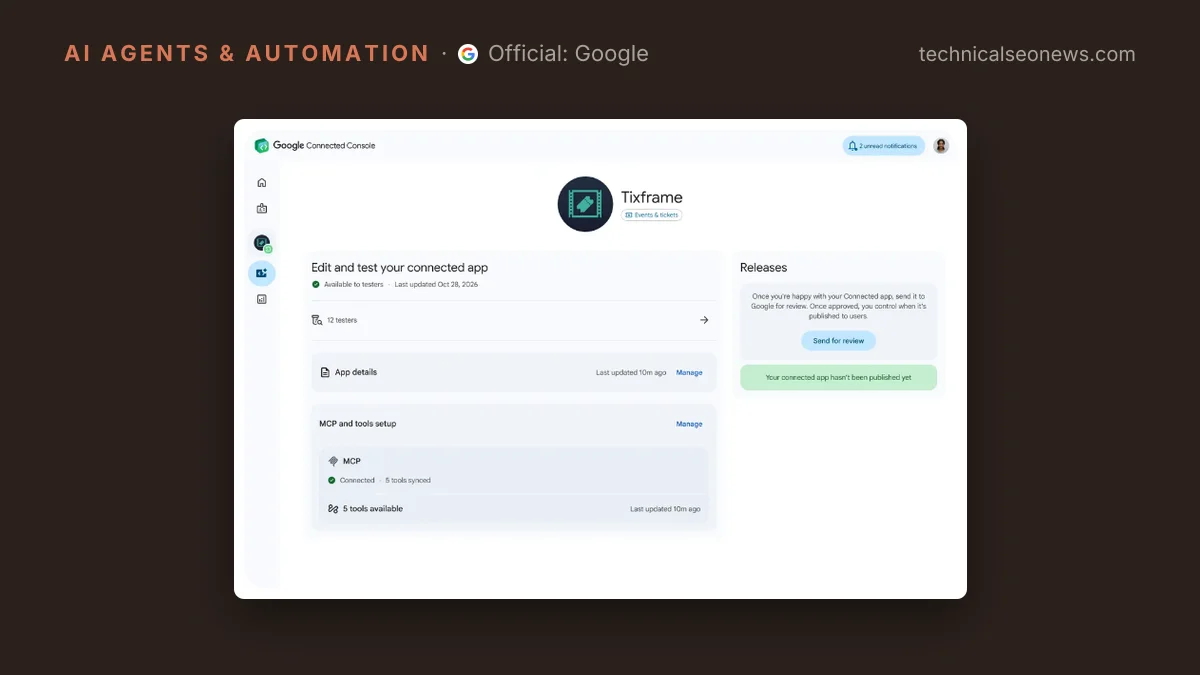
Google launched the preview of its Connected Apps Platform on October 28, which lets developers put an app’s functions inside Google Search and the Gemini app, per Google’s announcement. Developers connect a cloud-hosted MCP server, or Android MCP through the AppFunctions APIs, then register, test and submit the app in a new Google Connected Console. MCP, the Model Context Protocol, is a standard way to expose a tool’s functions so a model can call them.
Shipping the app is not the same as reaching anyone. Barry Schwartz, founder of Search Engine Roundtable, points out that a searcher has to add an app to their personalized Google Search settings before it does anything for them, and Google’s post does not mention that step. So the unit of distribution is a per-user install, much closer to an app-store download than to a ranking.
The console decides where the app can be installed at all. Before review, a developer chooses whether the app goes live in Search, in the Gemini app, or both. Once it is live, the console reports traffic, latency and error rates, and holds the brand controls, including verified logos and authenticated accounts.
Those latency and error figures are the part most teams will underrate. Google’s post does not say reliability affects distribution, but a platform that measures your error rate has what it needs to act on it, and an MCP server that times out is useless inside an answer regardless. The endpoint needs the monitoring and on-call rotation that a production API gets.
Google lists more than 50 Connected Apps across Search and Gemini, in areas from productivity and event ticketing to health and fitness. Partners including Adobe and Peloton are live in the Gemini app, with Search following in the coming weeks. Access during preview is phased, and Google says it will add developers, markets and products over the coming months.
Marie Haynes, an SEO consultant who publishes on Google’s updates, called the launch “something even bigger for Search Marketers” in a post on X quoted by Search Engine Roundtable. Her argument is that Search spent 25 years connecting people to websites for information, and that a business now gets found if it helps people and their agents get something done. She ties that to Sundar Pichai, Google’s CEO, saying Search will become an agent manager, though Pichai has also said that agents will browse sites before protocols mature. Connected Apps is the protocol path arriving early. Google’s John Mueller, who says he does not work on the product, called it extremely early in a LinkedIn post quoted in the same piece.
On what Google has published so far, this is a distribution channel with none of the levers an SEO team normally pulls. There is no query to rank for, no page to improve and no crawl to tune. There is an endpoint, a registration, a review, and a user who has to pick you. Usage lands in Google’s console rather than in site analytics, which is the same blind spot that chatbot page fetches already create.
What to do
If the business has an app with functions worth calling, the work now is organizational rather than technical.
- Name the owner before anyone registers anything. The team holding the Connected Console account controls the verified logo, the authenticated-account connection and the choice of Search, Gemini or both, so brand and search need a seat on it, not a readout afterwards.
- Decide scope deliberately rather than by default. Partner integrations are live in the Gemini app today with Search arriving in the coming weeks, so submitting for both is the way to be present as Search opens.
- Treat the MCP server as production infrastructure. Google measures and reports both latency and errors, so alerting, error budgets and an on-call rotation matter more here than anything on the marketing side.
- Plan how users will be told to add the app. Approval produces no usage on its own, so the launch needs a prompt in your own app, email and help docs.
- Pull the console’s traffic, latency and error numbers into whatever reporting the team already runs. Nothing else will show this channel.
For everyone without an app, there is nothing to implement yet. The thing worth watching is which categories fill up during preview, since a competitor sitting inside the answer as a callable function is a different problem from one ranking above you.