307 redirects hit both brands but only one fell out of Google
Summary
Temporary redirects slow a migration down, but in this r/bigseo thread they hit both brands equally. The brand that fell out of Google also had a sitemap Google could not read, which likely left its new URLs with fewer ways to be chosen as canonical.
For any move, launch with 301s, a sitemap Google can read that lists the new URLs, and self-referencing canonicals on every page, homepage included. Judge recovery over months, not weeks.
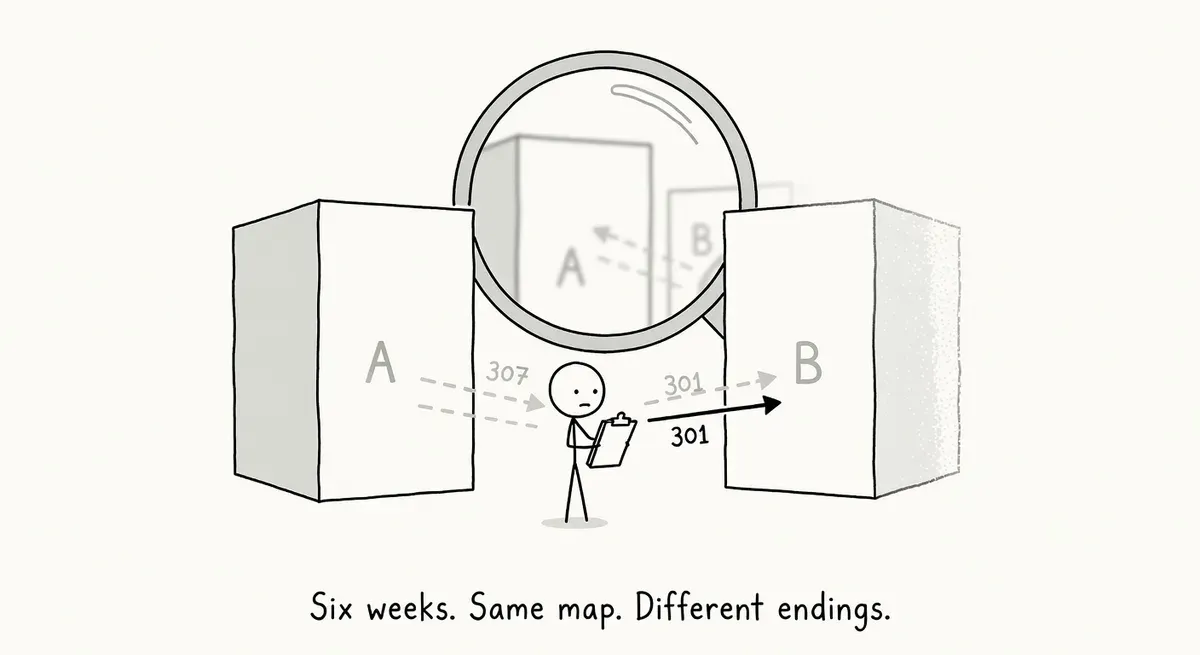
Two clothing brands were moved onto subdomains of a larger parent brand’s domain the same way, with the same six weeks of temporary redirects, and only one of them is recovering. The other has nearly left Google’s index, according to a post on r/bigseo, a Reddit forum for SEO practitioners, by u/DylanRSEO, a member of the team that ran the migration. The poster blames the redirects. The redirects cannot explain why the brands diverged, because both got them. The only problem the post reports for one brand and not the other is a sitemap Google could not read.
The team launched with 307 (temporary) redirects and switched to 301s after about six weeks. By the time of the post the 301s had been live for about 2.5 weeks, and Search Console showed a migration notice on both brands. Brand A, in the poster’s labels, is having its new URLs picked up as expected. Brand B has a handful of pages indexed on the new subdomain and a few dozen still on the old domain. Canonical tags on both brands are self-referencing everywhere except the homepages, which have none. Brand B’s sitemap “wasn’t being read correctly by Google” until the team re-uploaded it.
What the 307s cost
Google’s redirects documentation groups 307 with 302 and 303 as temporary redirects. Googlebot follows them, but the indexing pipeline does not use them as a signal that the target should be canonical. The new URL can still be chosen as canonical, but only on the other signals Google weighs. For six weeks, then, the new subdomains of both brands had to win canonical status on those other signals alone. The only reply in the thread, from another Reddit user, u/searchcandy, reaches the same conclusion: a 302 does what it was designed to do, and its only likely effect was to delay the start of the permanent move.
Where Brand B came up short
Google’s canonicalization page names the factors that feed the choice: HTTP or HTTPS, redirects, presence of the URL in a sitemap, and rel=“canonical” annotations. With the redirects not counting, Brand A still had a working sitemap behind its canonical tags. The post does not say how long Brand B’s sitemap went unread. If that overlapped the 307 period, Brand B’s new URLs had only self-referencing canonicals on inner pages to go on, and nothing on the homepage. The likelier explanation for the split is that Brand B’s new URLs had fewer canonical signals than Brand A’s, not that the 307s confused Google about one brand and not the other.
The missing homepage canonicals matter for the move as well. Google’s Change of Address help page lists a 301 from the old homepage to the new homepage as a step in any move made with the tool. The same page says that where the new site has equivalent pages, redirects plus rel=canonical tags reduce how many old URLs keep showing in Search. The migration notice on both brands matches what that page says appears once a Change of Address request passes its checks, so Google has the move on record for both.
Two and a half weeks is early to judge. The Change of Address page describes the move as running for 180 days, during which Google prefers the new site when picking canonicals, and it says Google does not erase the old site from the index. Brand B’s leftover old URLs are normal at this stage. The count of indexed new URLs is the number to track.
What to do
For a site in Brand B’s position:
- Confirm the re-uploaded sitemap lists the new subdomain URLs, the ones the 301s point to. A sitemap still listing old-domain URLs would send a signal against the redirects.
- Add a self-referencing canonical to the homepage.
- Check that each old URL returns one 301 straight to its equivalent new page, homepage to homepage.
- Keep the redirects for at least 180 days, as Google’s page advises, and longer if Google Search still sends traffic to them.
A quick check for steps 2 and 3, with your own hostnames:
curl -sI https://old-brand.example/ | grep -iE '^(HTTP|location)'
curl -s https://brand.parent.example/ | grep -i 'rel="canonical"'
For the next migration, launch with 301s on day one. A 307 left in the redirect config and a template with no homepage canonical are both the kind of error a staging crawl catches before launch.