A few specialist sites get more AI citations than big publishers
Summary
AI answers about a product category keep citing the same handful of specialist sites, and Semrush's guide says those sites beat national media even for a brand as large as Patagonia.
Run about 50 prompts on the AI platforms your buyers use, then chase placement on the domains that at least three of them cite.
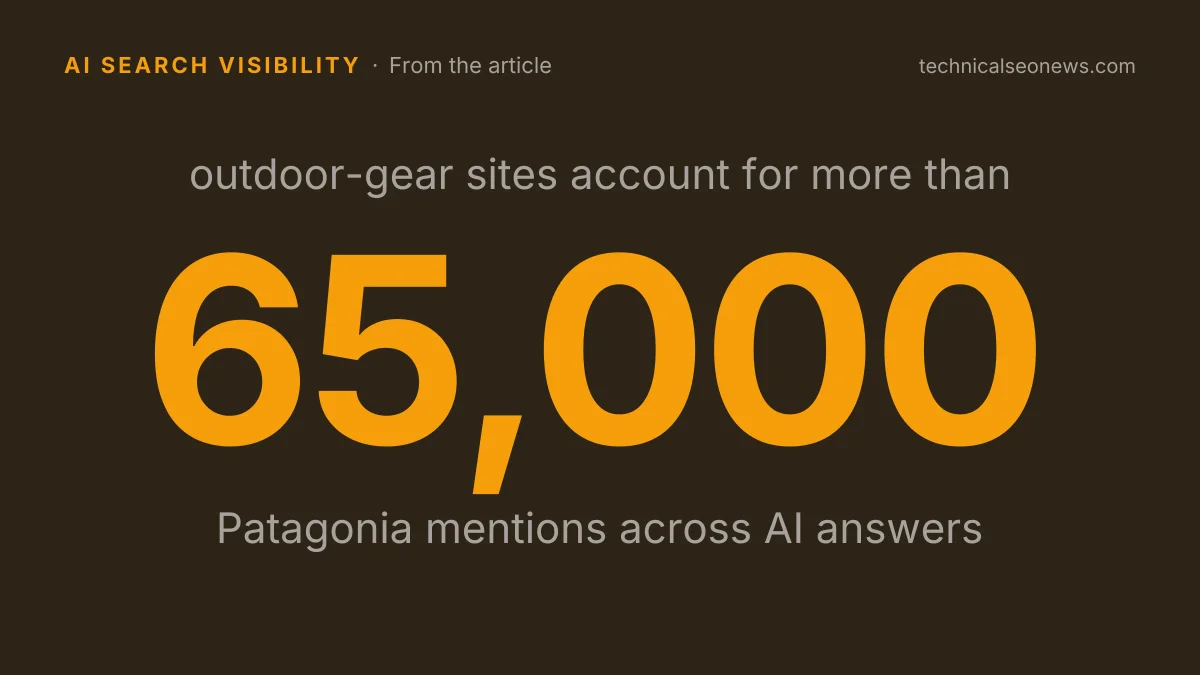
Semrush’s guide to what it calls citation core argues that AI answers about a category keep returning to the same handful of third-party sites, and that those sites are usually category specialists rather than large publishers. Citing its own AI Visibility Index, the guide says six specialist outdoor-gear sites account for more than 65,000 Patagonia mentions across AI answers, more than all Tier 1 traditional media combined.
Finance shows the ordering more sharply. In that index, which Semrush describes as covering 126 million prompts, NerdWallet, Investopedia and Bankrate received more AI citations in finance than general business publishers such as Forbes and The Wall Street Journal. The guide names the sites it found in three more categories:
| Category | Sites cited most |
|---|---|
| Software (US) | G2, Capterra, TrustRadius, Forbes Advisor |
| Beauty | Allure, Byrdie |
| Travel | TripAdvisor |
The useful part is how short the list is. When a category’s citations sit on a handful of domains, third-party placement can be planned the way link building was: a named target list, a pitch, a review profile, a product listing. A submission to Capterra is a task with a deadline. “Build authority” is not.
Keep one list per market rather than one global list, because the guide’s own example splits by country. AI answers about cars lean on Kelley Blue Book and Edmunds in the US, and on AutoTrader and What Car? in the UK.
Getting your own list is prompt work rather than keyword work. Semrush’s method is to fix a narrow category (“contract management software” rather than “software”), one country and a set of platforms, write around 50 prompts spread across awareness, consideration and decision questions, run that same set on every platform in scope, and keep the domains cited by at least three of the four platforms. Ranking data will not shortcut the step, since the pages AI answers cite are often not the ones ranking on page one.
Two cautions sit around the method, and one of them is Semrush’s. The guide warns that AI referral traffic is a starting point rather than a complete picture, because people read an answer without clicking through, so the platforms sending visitors are not necessarily the ones buyers are using. The second is commercial: the steps call for Semrush’s Prompt Research and Prompt Tracking tools and the AI Traffic dashboard in its Traffic and Market Toolkit, though the guide concedes that manual prompting with the free worksheet it ships gets the same domain list, more slowly.
Placement on these sites also comes with company nobody picks. Pages that AI answers cite tend to name competitors alongside the brand, which is the trade for appearing in a comparison at all.
What to do
- Pick one product category and one country, narrow enough that every prompt shares a buying context.
- Write around 50 prompts across awareness, consideration and decision stages, pulled from sales and support questions, Search Console queries and community threads. Do not let one topic or stage dominate the set.
- Run the set on the platforms your buyers use, starting with ChatGPT, Google AI Mode, Gemini and Perplexity, and log the prompt, the platform, the cited URL and its domain.
- Keep the domains cited by at least three of the four platforms. That is the target list, and it is short enough to work through by hand. Order it by topic relevance, then how often each site is cited, then how much control you have over getting listed there.
- Treat the list as placement work: claim and update product profiles on the review sites, offer the publications original data they can cite, take part in the Reddit and Quora threads already being cited, and use PR for the major media or Wikipedia entries you cannot reach directly.